
Permit
Kosher

Permit

Trachinotus falcatus
Also known as

  • Great Pompano
  • Round Pompano

About Permit

See: Jacks

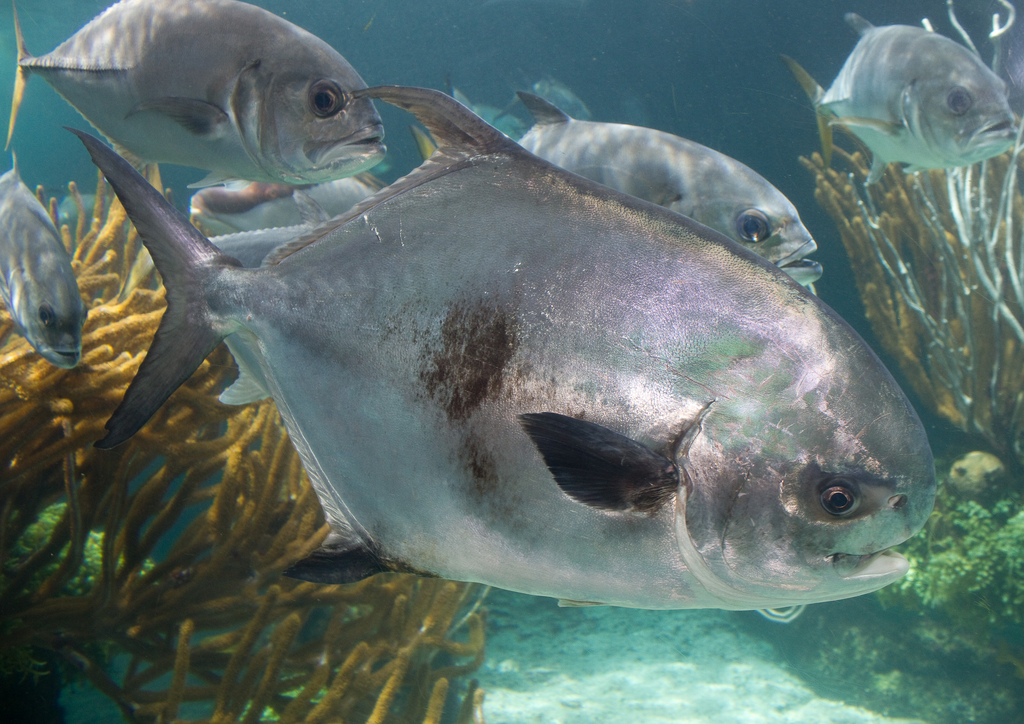
The permit (Trachinotus falcatus) is a game fish of the western Atlantic Ocean belonging to the family Carangidae. Adults feed on crabs, shrimp, and smaller fish. Taxonomy The permit was originally classified as Labrus falcatus, though the fish has since been placed in the genus Trachinotus. It is the type species of the genus Trachinotus. Etymology The permit’s genus name, Trachinotus comes from a fusion of the Greek words trachys (τραχύς), which means “rough”, and noton (νῶτον), meaning “back”. The species name for the permit, falcatus, is a Latin adjective, which roughly means “armed with scythes”. This serves as a reference to the permit’s dorsal fin that occasionally protrudes from the water when schools of permit feed near the surface. “Permit”, the common name, may be an irregular borrowing from Spanish palometa, probably from a Doric variant of Ancient Greek πηλαμύς (pēlamús, “young tuna”). Anatomy and morphology Permit can be distinguished by their elongated dorsal fins and anal fin. The dorsal fin is shaped like a scythe. Permit tails are also deeply forked, and their bodies are compressed laterally, making the fish tall and thin when viewed from the front…

The permit (Trachinotus falcatus) is a game fish of the western Atlantic Ocean belonging to the family Carangidae. Adults feed on crabs, shrimp, and smaller fish. Taxonomy The permit was originally classified as Labrus falcatus, though the fish has since been placed in the genus Trachinotus. It is the type species of the genus Trachinotus. Etymology The permit’s genus name, Trachinotus comes from a fusion of the Greek words trachys (τραχύς), which means “rough”, and noton (νῶτον), meaning “back”. The species name for the permit, falcatus, is a Latin adjective, which roughly means “armed with scythes”. This serves as a reference to the permit’s dorsal fin that occasionally protrudes from the water when schools of permit feed near the surface. “Permit”, the common name, may be an irregular borrowing from Spanish palometa, probably from a Doric variant of Ancient Greek πηλαμύς (pēlamús, “young tuna”). Anatomy and morphology Permit can be distinguished by their elongated dorsal fins and anal fin. The dorsal fin is shaped like a scythe. Permit tails are also deeply forked, and their bodies are compressed laterally, making the fish tall and thin when viewed from the front…

Image: Photo by Brian.gratwicke · licensed CC BY 3.0 · Wikimedia Commons