
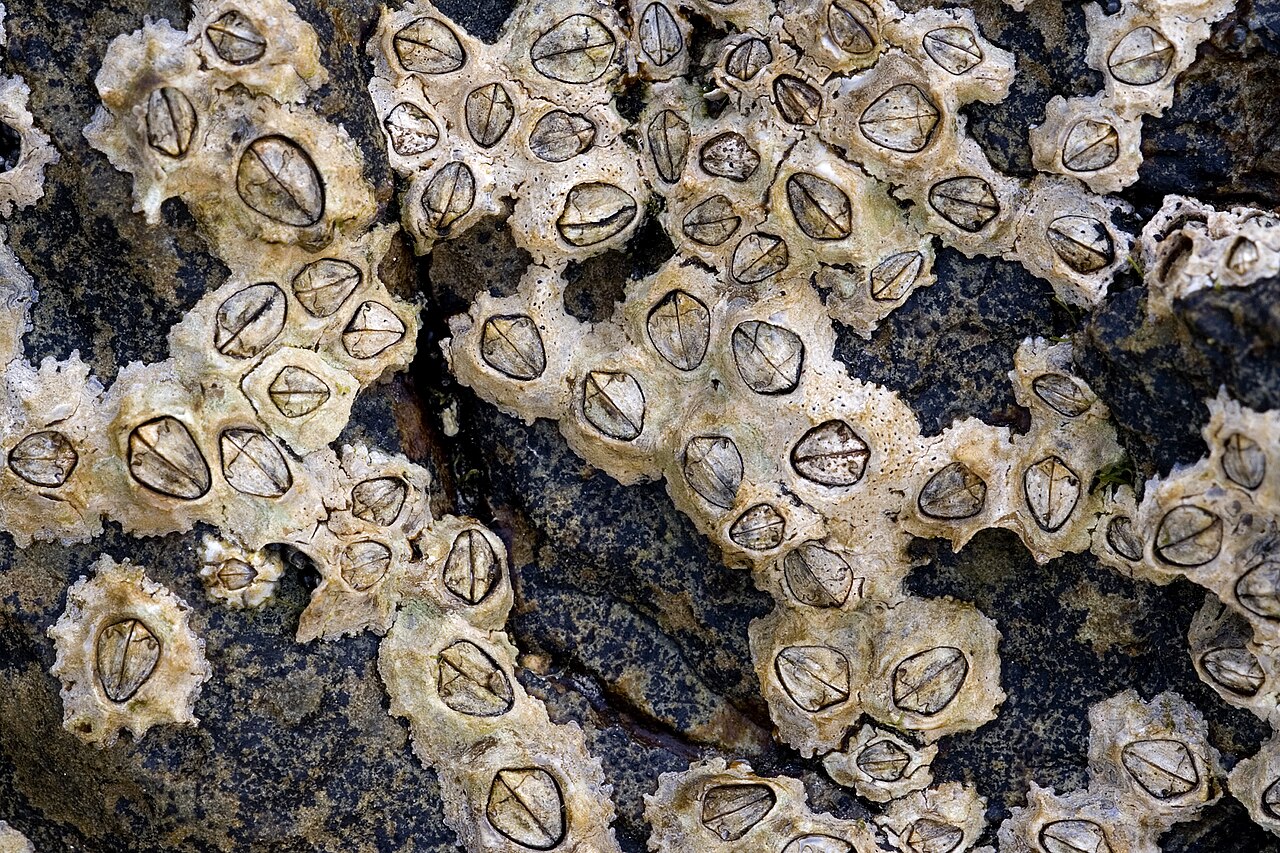
Barnacle
Cirripedia
Also known as
- Gooseneck barnacle
- Percebes
- Acorn barnacle
About Barnacle
Filter-feeding crustaceans that cement themselves to rocks, ships, and other hard surfaces.
Barnacles are arthropods of the subclass Cirripedia in the subphylum Crustacea. They are related to crabs and lobsters, with similar nauplius larvae. Barnacles are exclusively marine invertebrates; many species live in shallow and tidal waters. Some 2,100 species have been described. Barnacle adults are sessile; most are suspension feeders with hard calcareous shells, but the Rhizocephala are specialized parasites of other crustaceans, with reduced bodies. Barnacles have existed since at least the mid-Carboniferous, some 325 million years ago. In folklore, barnacle geese were once held to emerge fully formed from goose barnacles. Both goose barnacles and the Chilean giant barnacle are fished and eaten. Barnacles are economically significant as biofouling on ships, where they cause hydrodynamic drag, reducing efficiency. In culture, Barnacle Bill became a comic folktype of a seaman, appearing in several films and a drinking song.
Barnacles are arthropods of the subclass Cirripedia in the subphylum Crustacea. They are related to crabs and lobsters, with similar nauplius larvae. Barnacles are exclusively marine invertebrates; many species live in shallow and tidal waters. Some 2,100 species have been described. Barnacle adults are sessile; most are suspension feeders with hard calcareous shells, but the Rhizocephala are specialized parasites of other crustaceans, with reduced bodies. Barnacles have existed since at least the mid-Carboniferous, some 325 million years ago. In folklore, barnacle geese were once held to emerge fully formed from goose barnacles. Both goose barnacles and the Chilean giant barnacle are fished and eaten. Barnacles are economically significant as biofouling on ships, where they cause hydrodynamic drag, reducing efficiency. In culture, Barnacle Bill became a comic folktype of a seaman, appearing in several films and a drinking song. Etymology The word “barnacle” is attested in the early 13th century as Middle English “bernekke” or “bernake”, close to Old French “bernaque” and medieval Latin bernacae or berneka, denoting the barnacle goose. Because the full life cycles of both barnacles…
Image: Photo by MichaelMaggs · licensed CC BY-SA 3.0 · Wikimedia Commons
