
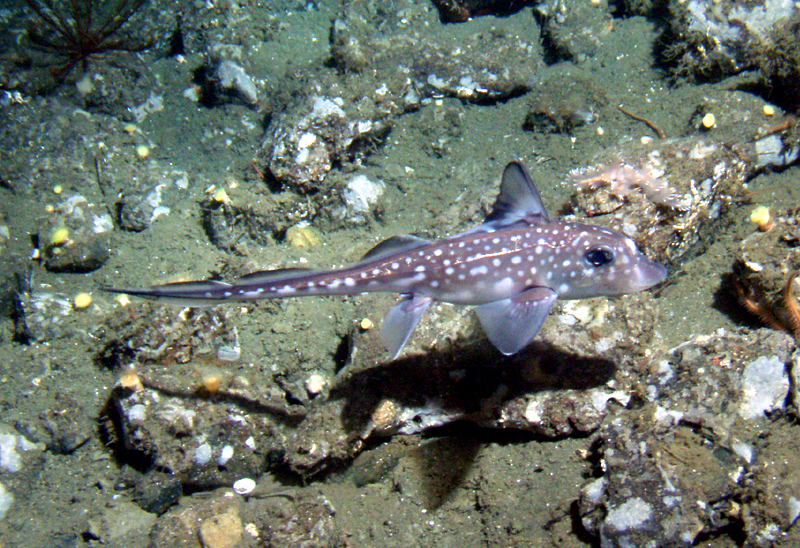
Ratfish
Not Kosher

Ratfish

Chimaera

Also known as

  • Chimaera
  • Ghost shark
  • Rabbitfish

About Ratfish

Cartilaginous deep-sea fish of the order Chimaeriformes.

Chimaeras are cartilaginous fish in the order Chimaeriformes (), known informally as ghost sharks, rat fish (not to be confused with rattails), spookfish, or rabbit fish; the last two names are also applied, respectively, to the ray-finned fish groups of Opisthoproctidae and Siganidae. At one time a “diverse and abundant” group (based on the fossil record), their closest living relatives are sharks and rays, though their last common ancestor with them lived nearly 400 million years ago. Living species (aside from plough-nose chimaeras) are largely confined to deep water.

Chimaeras are cartilaginous fish in the order Chimaeriformes (), known informally as ghost sharks, rat fish (not to be confused with rattails), spookfish, or rabbit fish; the last two names are also applied, respectively, to the ray-finned fish groups of Opisthoproctidae and Siganidae. At one time a “diverse and abundant” group (based on the fossil record), their closest living relatives are sharks and rays, though their last common ancestor with them lived nearly 400 million years ago. Living species (aside from plough-nose chimaeras) are largely confined to deep water. Anatomy Chimaeras are soft-bodied, shark-like fish with bulky heads and long, tapered tails; measured from the tail, they can grow up to 150 cm (4.9 ft) in length. Like other members of the class Chondrichthyes, chimaera skeletons are entirely cartilaginous, or composed of cartilage. Males use forehead denticles to grasp a female by a fin during copulation. The gill arches are condensed into a pouch-like bundle covered by a sheet of skin (an operculum), with a single gill-opening in front of the pectoral fins. The pectoral fins are large enough to generate lift at a relaxed forward momentum, giving the chimaera…

Not kosher. Ratfish are cartilaginous fish, closely related to sharks and rays.

Image: Photo by Linda Snook / MBNMS · licensed Public domain · Wikimedia Commons