Is Bowfin kosher?
No — Bowfin is not kosher under Jewish dietary law.
Not kosher. Bowfin have ganoid-like scales that do not qualify halachically. Their roe is sometimes sold as "Choupiquet Royale" caviar and is also not kosher.
About Bowfin
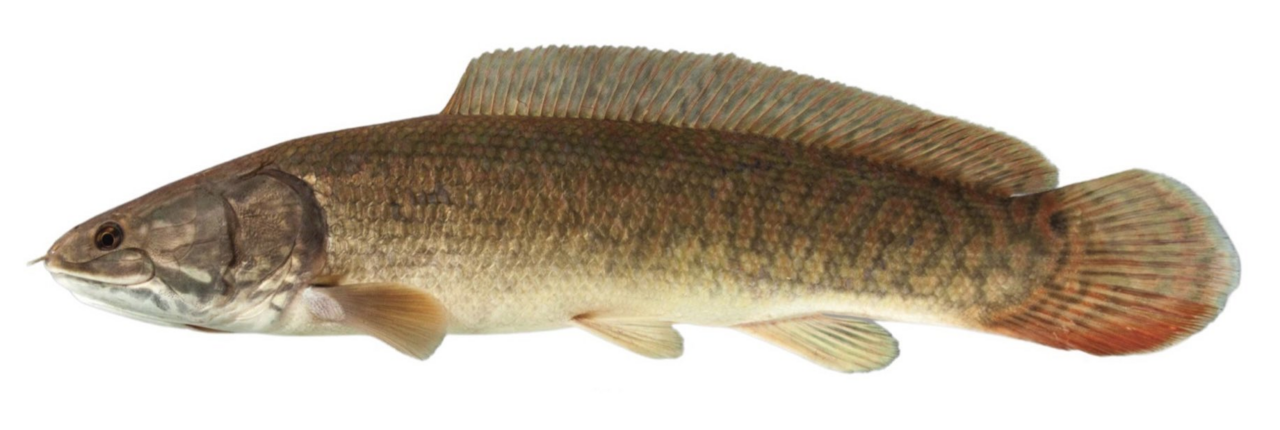
A primitive freshwater fish native to eastern North America, unchanged for roughly 100 million years. The ruddy bowfin (Amia calva) is a ray-finned fish native to North America. Common names include mudfish, mud pike, dogfish, grindle, grinnel, swamp trout, and choupique. It is regarded as a relict, being one of only two surviving species of the Halecomorphi, a group of fish that first appeared during the Early Triassic, around 250 million years ago. The bowfin is often considered a "living fossil" because they have retained some morphological characteristics of their early ancestors. It is one of two species in the genus Amia, along with Amia ocellicauda, the eyespot bowfin. The closest living relatives of bowfins are gars, with the two groups being united in the clade Holostei. Bowfins are demersal freshwater piscivores, commonly found throughout much of the eastern United States, and in southern Ontario and Quebec. Fossil deposits indicate Amiiformes were once widespread in both freshwater and marine environments across North and South America, Europe, Asia, and Africa. Now, their range is limited to much of the eastern United States and adjacent southern Canada, including the drainage basins of the Mississippi River, Great Lakes, and various rivers exiting in the Eastern Seaboard or Gulf of Mexico. Their preferred habitat includes vegetated sloughs, lowland rivers and lakes, swamps, and backwater areas; they are also occasionally found in brackish water. They are stalking, ambush predators known to move into the shallows at night to prey on fish and aquatic invertebrates such as crawfish, mollusks, and aquatic insects. Like gars, bowfin are bimodal breathers—they have the capacity to breathe both water and air. The ruddy bowfin (Amia calva) is a ray-finned fish native to North America. Common names include mudfish, mud pike, dogfish, grindle, grinnel, swamp trout, and choupique. It is regarded as a relict, being one of only two surviving species of the Halecomorphi, a group of fish that first appeared during the Early Triassic, around 250 million years ago. The bowfin is often considered a "living fossil" because they have retained some morphological characteristics of their early ancestors. It is one of two species in the genus Amia, along with Amia ocellicauda, the eyespot bowfin. The closest living relatives of bowfins are gars, with the two groups being united in the clade Holostei. Bowfins are demersal freshwater piscivores, commonly found throughout much of the eastern United States, and in southern Ontario and Quebec. Fossil deposits indicate Amiiformes were once widespread in both freshwater and marine environments across North and South America, Europe, Asia, and Africa. Now, their range is limited to much of the eastern United States and adjacent southern Canada, including the drainage basins of the Mississippi River, Great Lakes, and various rivers exiting in the Eastern Seaboard...
Kosher ruling
Source: Orthodox Union; Wikipedia (CC BY-SA 3.0); Wikipedia (CC BY-SA 3.0)
Look up another fish
Related species
Not Kosher Burbot
Lota lotaEelpout, Lawyer
Not Kosher Catfish
SiluriformesChannel catfish, Blue catfish, Flathead catfish
Not Kosher Conger eel
Conger congerConger, European conger, Sea conger
Not Kosher Cusk-eel
OphidiidaeCusk eel
Not Kosher Eel
Anguilla anguillaEuropean eel, American eel, Anguilla
Not Kosher Electric eel
Electrophorus electricusPoraquê