Is Brill kosher?
Yes — Brill is kosher under Jewish dietary law.
Brill has fins and scales, which are the two requirements for kosher fish under Jewish dietary law (Leviticus 11:9-12).
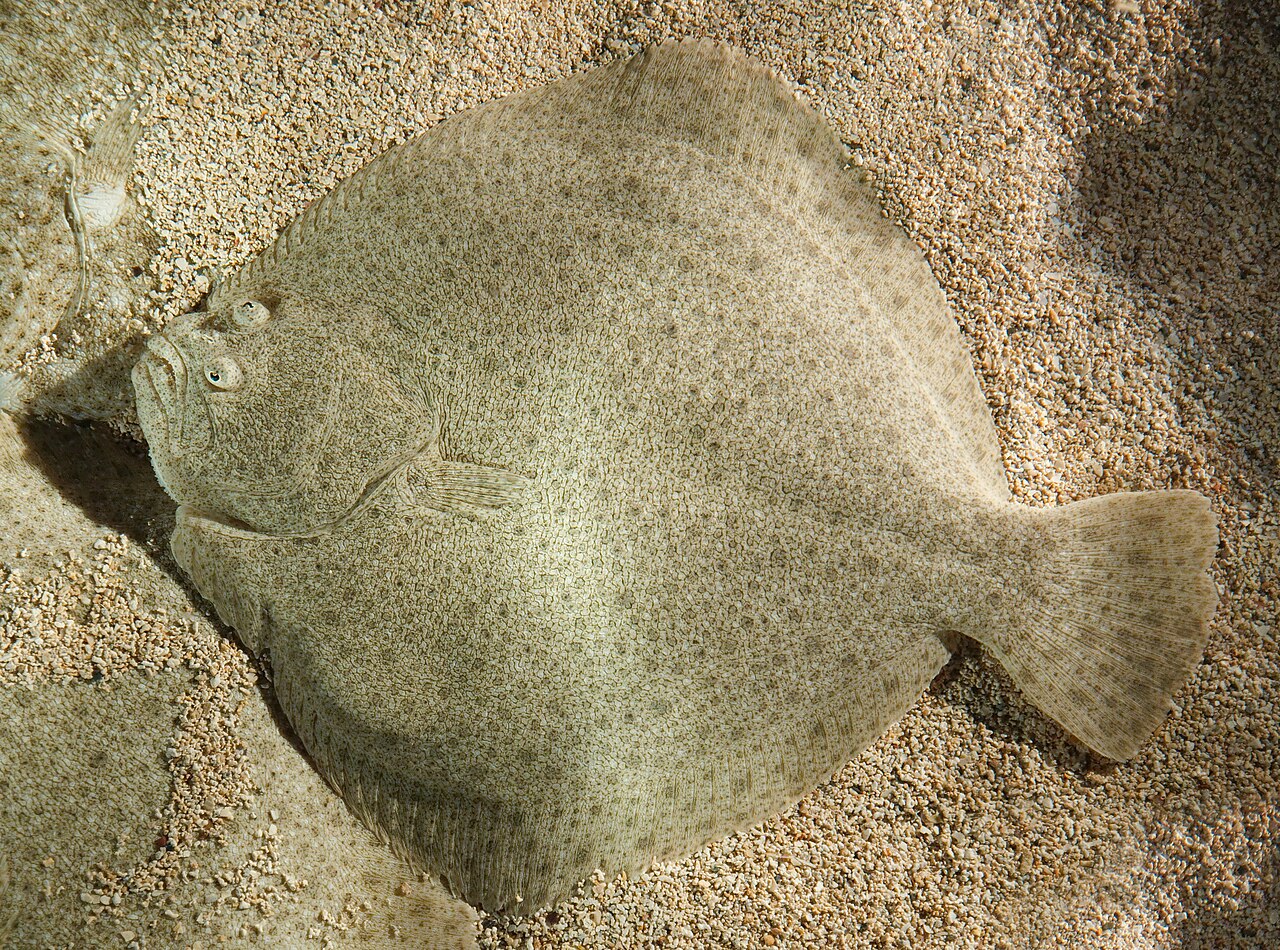
Image: Photo by Luc Viatour · licensed CC BY-SA 3.0 · source
About Brill
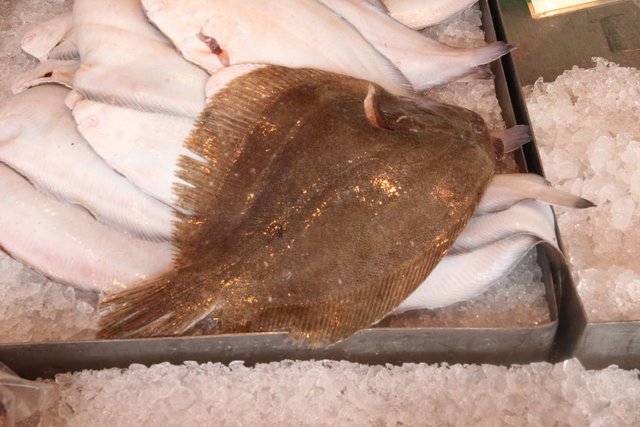
See: Flounder The turbot ( TUR-bət), Scophthalmus maximus, is a relatively large species of flatfish in the family Scophthalmidae. It is a demersal fish native to marine or brackish waters of the Northeast Atlantic, Baltic Sea and the Mediterranean Sea. It is an important food fish. Turbot in the Black Sea were often included in this species, but are now generally regarded as separate: the Black Sea turbot or kalkan (S. maeoticus). True turbot are not found in the Northwest Atlantic; the "turbot" of that region, which was involved in the so-called "Turbot War" between Canada and Spain, is the Greenland halibut or Greenland turbot (Reinhardtius hippoglossoides). The name turbot can refer to any member of the family Scolopthalmidae, and some other flatfish have similar common names (e.g., spiny turbots of the genus Psettodes). The turbot ( TUR-bət), Scophthalmus maximus, is a relatively large species of flatfish in the family Scophthalmidae. It is a demersal fish native to marine or brackish waters of the Northeast Atlantic, Baltic Sea and the Mediterranean Sea. It is an important food fish. Turbot in the Black Sea were often included in this species, but are now generally regarded as separate: the Black Sea turbot or kalkan (S. maeoticus). True turbot are not found in the Northwest Atlantic; the "turbot" of that region, which was involved in the so-called "Turbot War" between Canada and Spain, is the Greenland halibut or Greenland turbot (Reinhardtius hippoglossoides). The name turbot can refer to any member of the family Scolopthalmidae, and some other flatfish have similar common names (e.g., spiny turbots of the genus Psettodes). Etymology The word comes from the Old French tourbout, which may be a derivative of the Latin turbo ('spinning top'), a possible reference to its shape. Another possible origin of the Old French word is from Old Swedish törnbut, from törn 'thorn' + -but 'stump, butt, flatfish', which may also be a reference to its shape (compare native English halibut). Early reference...
Source: kosherfish.co/kosher-fish-list (snapshot 2025-12-19); Wikipedia (CC BY-SA 3.0); Wikipedia (CC BY-SA 3.0)