Is Opaleye kosher?
Yes — Opaleye is kosher under Jewish dietary law.
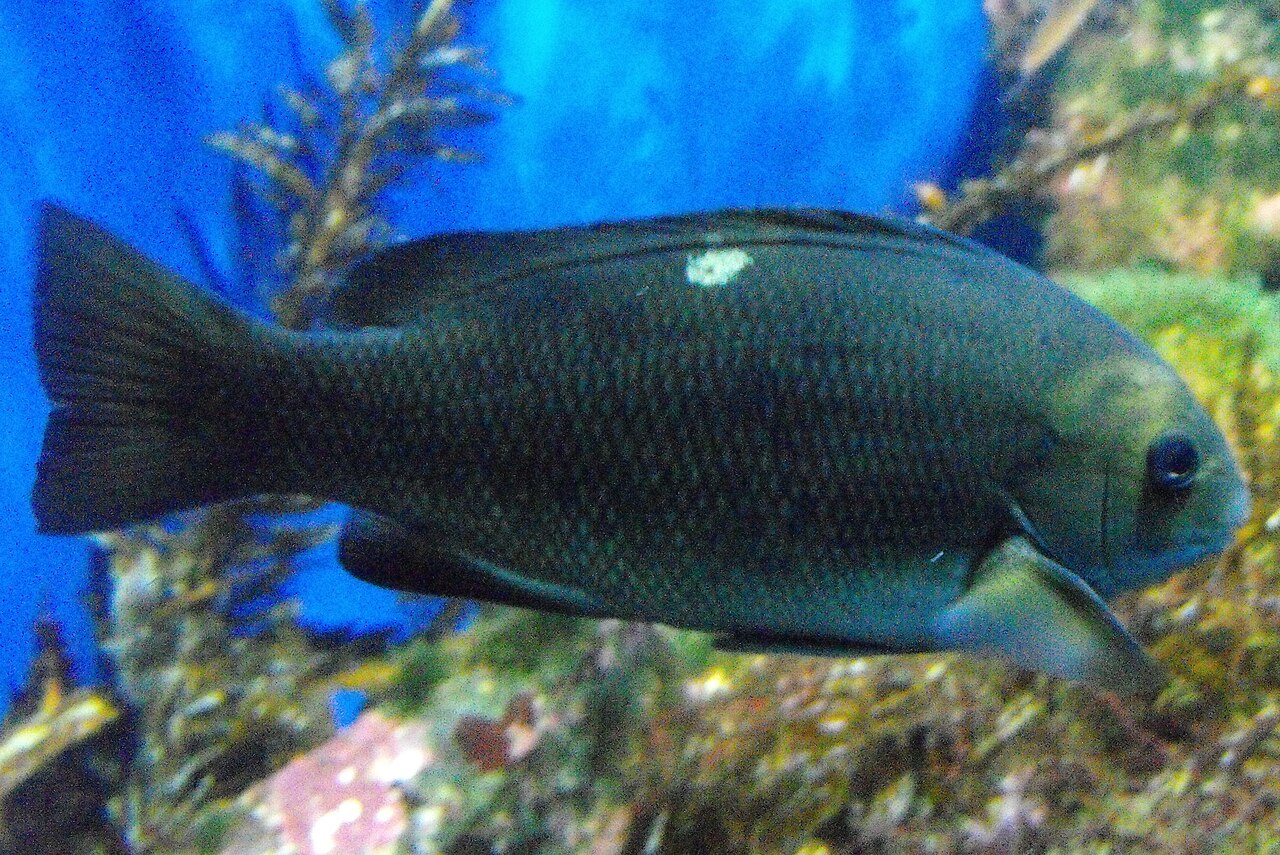
Opaleye has fins and scales, which are the two requirements for kosher fish under Jewish dietary law (Leviticus 11:9-12).
Image: Photo by Stickpen · licensed Public domain · source
About Opaleye
See: Sea chubs Girella nigricans, commonly known as the opaleye or rudderfish, is a species of sea chub found in the Eastern Pacific, from California to southern Baja California. A rarely documented isolated population also exists in the Gulf of California, which might be genetically different from the rest of the species. They are commonly found in shallow waters and intertidal zones, usually over rocks and kelp beds, at depths of 1 to 32 m (3.3 to 105.0 ft). They feed primarily on algae, but will occasionally consume sessile invertebrates (including crustaceans, worms, and molluscs). They are considered commercially important game fish. Girella nigricans, commonly known as the opaleye or rudderfish, is a species of sea chub found in the Eastern Pacific, from California to southern Baja California. A rarely documented isolated population also exists in the Gulf of California, which might be genetically different from the rest of the species. They are commonly found in shallow waters and intertidal zones, usually over rocks and kelp beds, at depths of 1 to 32 m (3.3 to 105.0 ft). They feed primarily on algae, but will occasionally consume sessile invertebrates (including crustaceans, worms, and molluscs). They are considered commercially important game fish. Species Description The body of Girella nigricans is laterally compressed and oval in shape. The snout is blunt and short, with a thick-lipped small mouth located at the front. The species is dentally polymorphic, with some juveniles transitioning from tricuspid teeth to simple teeth. The fins are all relatively short and rounded to blunt in shape. The dorsal fin is continuous and the tail fin has a straight margin. The dorsal fin of opaleye consists of soft rays and spines, in which the dorsal soft rays are longer or about equal to the dorsal spines. The dorsal...
Source: kosherfish.co/kosher-fish-list (snapshot 2025-12-19); Wikipedia (CC BY-SA 3.0); Wikipedia (CC BY-SA 3.0)