Is Sand Lance kosher?
No — Sand Lance is not kosher under Jewish dietary law.
Not kosher.
Image: Photo by Walter Baxter · licensed CC BY-SA 2.0 · source
About Sand Lance
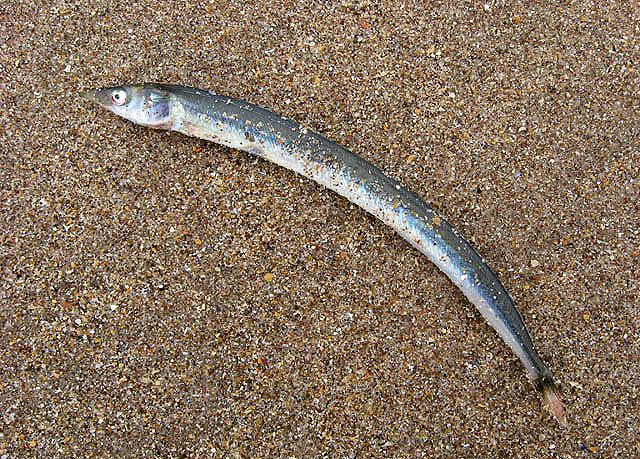
Raitt's sand eel (Ammodytes marinus), is a small semi-pelagic ray-finned fish found in the North Atlantic Ocean. The Raitt's sand eel is member of the family Ammodytidae which includes all 31 species of sand eels, often referred to as sand lances. Contrary to their name sand eels, including Raitt's sand eel, are not true eels and instead belong to the order of "weever-like" fishes, the Trachiniformes. Description The Raitt's sand eel is a small elongated fish that is usually about 20 cm long. The maximum length reported for this species of sand eel is 25 cm. They are silver all over with darker scales on their dorsal side. Raitt's sand eels have a short tail fin that is deeply forked. They have a long and low dorsal fin that is twice as long as the tail fin and runs along almost the entire body. The scales on their underside are arranged randomly instead of in a distinct pattern as in many other fish. The Raitt's sand eel has a pointed jaw where the lower jaw projects further than the upper jaw. It is difficult to distinguish this species from the other members in its genus ‘’Ammodytes’’ as they are all very similar in appearance. Evolution The evolutionary history of the... Vipera ammodytes, commonly known as horned viper, long-nosed viper, nose-horned viper, and sand viper, is a species of viper found in northern Italy, the Balkans, and parts of Asia Minor. Like all other vipers, it is venomous. It is reputed to be the most dangerous of the European vipers due to its large size, long fangs (up to 13 mm) and high venom toxicity. The specific name, ammodytes, is derived from the Greek words ammos, meaning "sand", and dutes, meaning "burrower" or "diver", despite its preference for rocky habitats. Five subspecies are currently recognized, including the nominate subspecies described here. Description V. ammodytes grows to an average total length (snout-tail) of 85 cm (33.5 in), although individuals usually measure less than 75 cm (29.5 in). Maximum length also depends on locality, with northern forms distinctly larger than southern ones. In one field study on Golem Grad island (in North Macedonia), for example, females averaged 35 cm., and males at 37 cm.; the largest captured during the study was a male, at 66 cm. long. This indicates some degree of regional or insular dwarfism. The head is covered in small, irregular scales, that are either smooth...
Kosher ruling
Source: legacy csv; manual override 2025-12-19; Wikipedia (CC BY-SA 3.0); Wikipedia (CC BY-SA 3.0)