Is Sea anemone kosher?
No — Sea anemone is not kosher under Jewish dietary law.
Not kosher. Sea anemones are cnidarians — the same phylum as jellyfish — with no fins or scales.
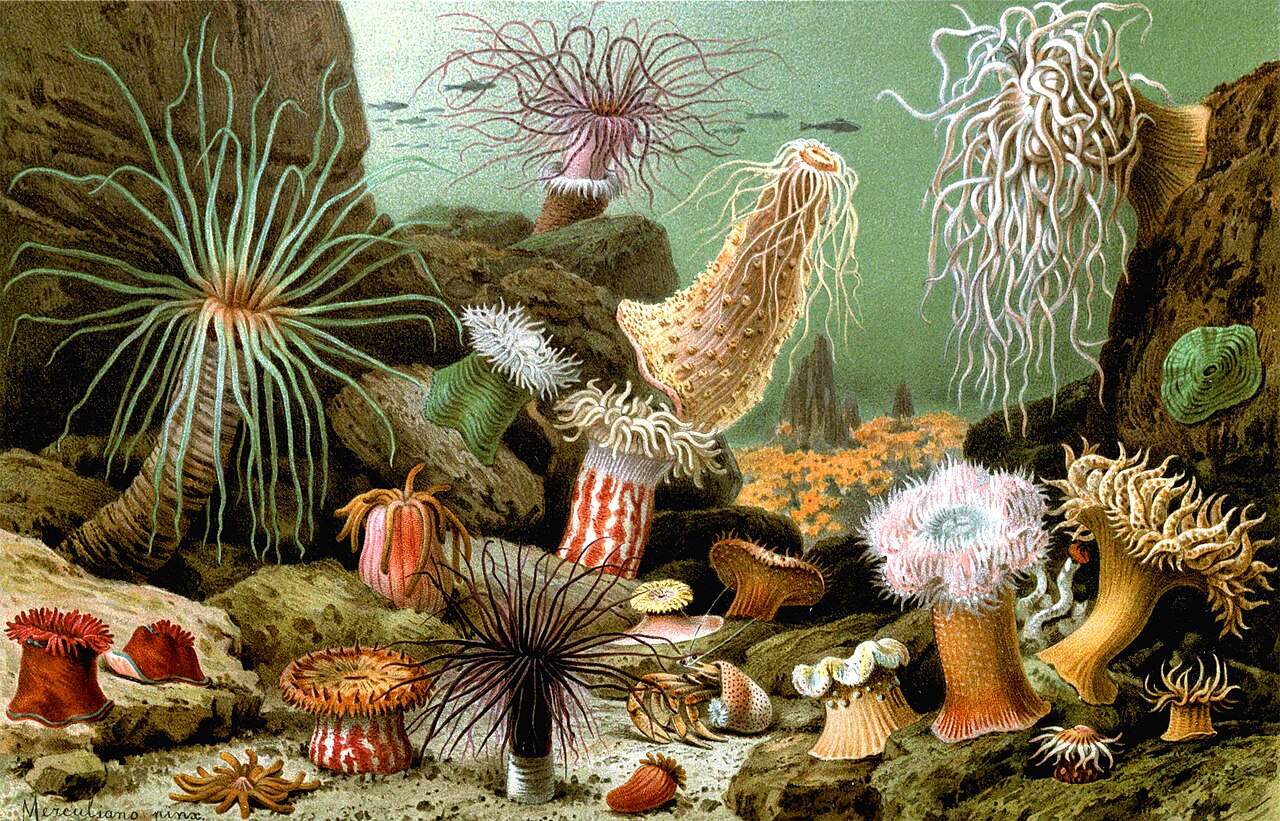
Image: Photo by Giacomo Merculiano · licensed Public domain · source
About Sea anemone
Colorful, flower-shaped marine invertebrates; eaten in southern European cuisine (ortiguilla). Sea anemones ( ə-NEM-ə-nee) are a group of predatory marine invertebrate animals constituting the order Actiniaria. Because of their colourful appearance, they are named after the Anemone, a terrestrial flowering plant. Sea anemones are classified in the phylum Cnidaria, class Anthozoa, subclass Hexacorallia. As cnidarians, sea anemones are related to corals, jellyfish, tube-dwelling anemones, and Hydra. Unlike jellyfish, sea anemones do not have a medusa stage in their life cycle. A typical sea anemone is a single polyp attached to a hard surface by its base, but some species live in soft sediment, and a few float near the surface of the water. The polyp has a columnar trunk topped by an oral disc with a ring of tentacles and a central mouth. The tentacles can be retracted inside the body cavity or expanded to catch passing prey. They are armed with cnidocytes (stinging cells). In many species, additional nourishment comes from a symbiotic relationship with single-celled dinoflagellates, with zooxanthellae, or with green algae, zoochlorellae, that live within the cells. Some species of sea anemone live in association with clownfish, hermit crabs, small fish, or other animals to their mutual benefit. Sea anemones breed by liberating sperm and eggs through the mouth into the sea. The resulting fertilized eggs develop into planula larvae which, after being planktonic for a while, settle on the seabed and develop directly into juvenile polyps. Sea anemones also breed asexually, by breaking in half or into smaller pieces which regenerate into polyps. Sea anemones are sometimes kept in reef aquariums; the global trade in marine ornamentals for this purpose is expanding and threatens sea anemone populations in some localities, as the trade depends on collection from the wild. Sea anemones ( ə-NEM-ə-nee) are a group of predatory marine invertebrate animals constituting the order Actiniaria. Because of their colourful appearance, they are named after the Anemone, a terrestrial flowering plant. Sea anemones are classified in the phylum Cnidaria, class Anthozoa, subclass Hexacorallia. As cnidarians, sea anemones are related to corals, jellyfish, tube-dwelling anemones, and Hydra. Unlike jellyfish, sea anemones do not have a medusa stage in their life cycle. A typical sea anemone is a single polyp attached to a hard surface by its base, but some species live in soft sediment, and a few float near the surface of the water. The polyp has a columnar trunk topped by an oral disc with a ring of tentacles and a central mouth. The tentacles can be retracted inside the body cavity or expanded to catch passing prey. They are armed with cnidocytes (stinging cells). In many species, additional nourishment comes from a symbiotic relationship with single-celled dinoflagellates, with zooxanthellae, or with green algae, zoochlorellae, that live within the cells. Some species of sea anemone live in association with clownfish, hermit crabs, small fish, or other animals to their...
Kosher ruling
Source: Orthodox Union; Wikipedia (CC BY-SA 3.0); Wikipedia (CC BY-SA 3.0)
Look up another fish
Related species
Not Kosher Sea cucumber
HolothuroideaBêche-de-mer, Trepang, Sea slug
Not Kosher Sea slug
NudibranchiaNudibranch
Not Kosher Sea urchin
EchinoideaUni
Not Kosher Abalone
HaliotisPaua, Ormer
Not Kosher Barnacle
CirripediaGooseneck barnacle, Percebes, Acorn barnacle
Not Kosher Clam
BivalviaQuahog, Littleneck, Cherrystone