Shad
Alosa sapidissima
Also known as
- American Shad
- White Shad
- Atlantic Shad
- Potomac Shad
About Shad
See: Herrings
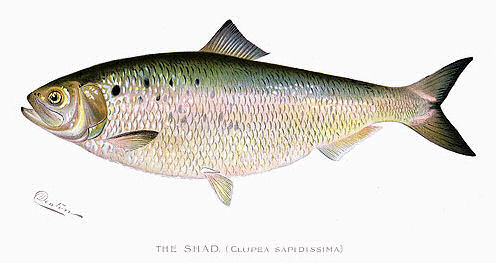
The American shad (Alosa sapidissima) is a species of anadromous clupeid fish naturally distributed on the North American coast of the North Atlantic, from Newfoundland to Florida, and as an introduced species on the North Pacific coast. The American shad is not closely related to the other North American shads. Rather, it seems to form a lineage that diverged from a common ancestor of the European taxa before these diversified. The American shad has been described as “the fish that fed the (American) nation’s founders”. Adult shad weigh between 1.5 and 3.5 kg (3 and 8 lb), and they have a delicate flavor when cooked. It is considered flavorful enough not to require sauces, herbs, or spices. It can be boiled, filleted and fried in butter, or baked. Traditionally, a little vinegar is sprinkled over it on the plate. In the Eastern United States, roe shads (females) are prized because the eggs are considered a delicacy. The name “shad” derives from the Old English sceadd, meaning “herring”; it is a cognate to Irish, Welsh, and Scottish Gaelic words for herring.
The American shad (Alosa sapidissima) is a species of anadromous clupeid fish naturally distributed on the North American coast of the North Atlantic, from Newfoundland to Florida, and as an introduced species on the North Pacific coast. The American shad is not closely related to the other North American shads. Rather, it seems to form a lineage that diverged from a common ancestor of the European taxa before these diversified. The American shad has been described as “the fish that fed the (American) nation’s founders”. Adult shad weigh between 1.5 and 3.5 kg (3 and 8 lb), and they have a delicate flavor when cooked. It is considered flavorful enough not to require sauces, herbs, or spices. It can be boiled, filleted and fried in butter, or baked. Traditionally, a little vinegar is sprinkled over it on the plate. In the Eastern United States, roe shads (females) are prized because the eggs are considered a delicacy. The name “shad” derives from the Old English sceadd, meaning “herring”; it is a cognate to Irish, Welsh, and Scottish Gaelic words for herring. Life history The shad spends most of its life in the Atlantic Ocean but after three to six years they become sexually mature…
Image: Photo by Shermon Foote Denton · licensed Public domain · Wikimedia Commons