
What is a mashgiach? A mashgiach is the kosher supervisor who checks that a food business follows kosher law. The word means “supervisor” or “overseer” in Hebrew, and the Orthodox Union (OU) says a mashgiach “supervises kosher food production to ensure compliance with halacha.” If you want to know whether a fish is kosher before it reaches any kitchen, the KosherFish lookup tool answers that. The mashgiach covers the next step, the cutting, cooking, and serving.
What Is a Mashgiach and What Does the Job Involve?
A mashgiach (plural mashgichim) reviews ingredients, watches the cooking, and checks the equipment for residual non-kosher food. That list comes straight from the OU’s own explainer. The job is hands-on. A mashgiach stands in the kitchen, plant, or store and sees what goes into the food.
The work has also grown more technical. The OU says a modern mashgiach needs a working grasp of food chemistry, biology, and technology. The OU gives enzymes such as amylase and rennet as the example, because an enzyme can come from microbes or plants, and the mashgiach has to know which. Fermentation gets the same scrutiny.
Training matters too. According to the OU, becoming a mashgiach takes rigorous training in kosher laws and a Jewish education, and the path ends in smicha, or rabbinic ordination. It starts with intensive study of the Torah and Talmud.
What Is a Mashgiach Temidi?
A mashgiach temidi is a supervisor who is present all the time. “Temidi” means “continuous” in Hebrew, and the OU describes the principle as uninterrupted supervision by a certified mashgiach. It matters most in dairy and wine production, where the OU says even a brief lapse in oversight could compromise the kosher status of an entire batch.
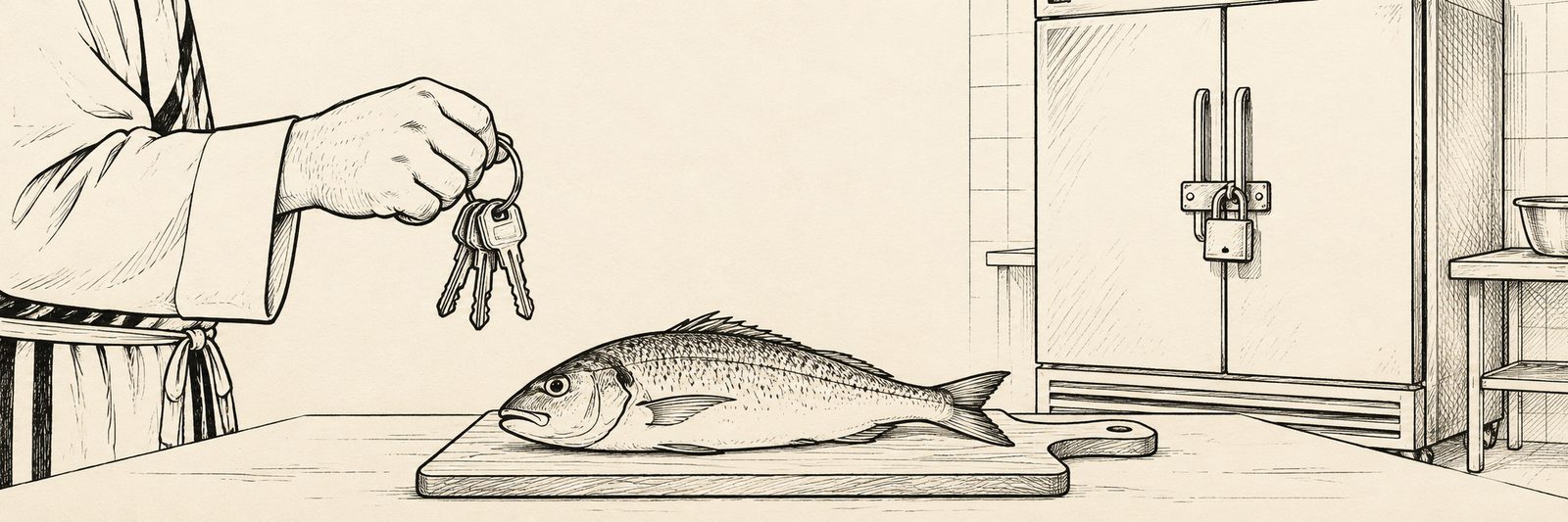
Restaurants work the same way. In its profile of an OU restaurant, the OU states that a restaurant “needs constant supervision,” so it requires a full-time onsite mashgiach temidi. The OU supplies the supervisor and the owner pays for the service. The OU restaurant profile adds that this person is the only one who holds the keys to the refrigerators, freezers, ovens, and cabinets.
What Does a Mashgiach Check in a Kosher Kitchen?
The OU walks through a restaurant mashgiach’s ordinary day, and it looks like this.
- Deliveries. The mashgiach checks that each product carries proper kosher certification before it goes on a shelf.
- Keys and access. They open the doors in the morning, lock the refrigerators, dry goods, wine, and front door at night, and control who gets into kosher-sensitive areas.
- Cooking. They turn on the ovens. The OU article says kosher law requires a Jew to take part in the cooking. For the rule behind it, see our guide to bishul yisrael.
- Eggs. They crack eggs and look for forbidden blood spots. Our guide on whether eggs are kosher explains why.
- Produce. They wash and inspect vegetables for bugs. One supervisor in the OU profile checks ten heads of Chinese cabbage a day.
One supervisor in that profile put the job this way: “Kosher customers are relying on me.” That reliance is the whole point of a mashgiach. The diner at the table can’t watch the kitchen, so someone trained does it for them.
How Does a Mashgiach Fit Into Fish Supervision?
Fish is where supervision pays off fastest. A whole fish with its skin and scales shows what it is, and you can read the signs yourself (see whether fish needs a hechsher). Once someone fillets it and removes the skin, the evidence is gone.
Rabbi Chaim Goldberg, a fish expert at the OU, wrote in a 2011 Ask OU Kosher column that “It is forbidden to purchase fish without skin,” unless kosher supervision covered the skinning. He also describes species substitution, where an unscrupulous seller mislabels a cheap product. His example is non-kosher basa, a catfish that many have labeled and sold as grouper, a kosher fish. You can read the verdicts for each fish in our posts on basa and grouper.
A supervisor who watches the fish being skinned closes that gap. Goldberg also raises a store problem. A non-certified store may cut its fish with knives that also touch non-kosher fish. In a supervised store or plant, the mashgiach is the person who prevents that. Our guide to buying kosher fish walks through what to look for at the counter.
Mashgiach vs Rabbi vs Hechsher: How They Differ
People mix these up, so this table sorts them out. The roles overlap, but each one does a different job.
| Term | What it is | What it does |
|---|---|---|
| Mashgiach | The on-site supervisor | Watches ingredients, equipment, and cooking as it happens (OU) |
| Rabbinic Field Representative (RFR) | The OU rabbi on the ground | The OU calls its full-time restaurant supervisor an RFR |
| Hechsher | The certification | The mark or letter that says a product or business meets a certifying agency’s standard |
| Your own rabbi | Your halachic guide | The person you ask when a case is unclear |
The hechsher is the label you see. The mashgiach is the work behind it. Our guides to the OU symbol and other kosher symbols cover the labels, and our post on Star-K shows how another agency handles supervision.
Do All Kosher Restaurants Have a Mashgiach?
No. The level of supervision depends on the agency and on what the place serves. The Chicago Rabbinical Council (cRc) food service policy spells it out. At a dairy or pareve place, a cRc representative usually drops in unannounced one to three times a week, a system called yotzeh v’nichnas (literally “goes out and comes in”). A place that serves meat needs both those visits and a full-time Sabbath-observant person on site, and the cRc requires a mashgiach temidi at some dairy places too. cRc staff set the exact level for each business. The OU’s restaurant profile, quoted above, says a restaurant needs constant supervision, so it calls for a mashgiach temidi.
So the certificate on the wall tells you who certifies the place, and that agency sets the terms. If you want to know whether someone is watching the kitchen right now, ask the certifying agency. Our kosher travel guide covers how to check a restaurant in a new city.
Where Else Do Mashgichim Work Besides Restaurants?
Mashgichim also work in factories and production plants. The OU article gives three examples. Rabbi Chaim Goldzweig found an overlooked non-kosher ingredient, and the discovery led to operational changes. Rabbi Yisroel P. Gornish researched a new food coloring derived from a vegetable source and consulted agricultural experts. Rabbi Avrohom Juravel supervised beverage flavoring production on a remote Pacific Island and resolved cross-contamination issues at an Indian spice factory.
The OU also runs an “Ask OU” program, so mashgichim answer consumer questions by phone and on social media. That’s useful for a shopper. If a product label confuses you, the certifying agency is the right place to ask, and your own rabbi is the right place for a ruling.
Check Any Fish with KosherFish
A mashgiach settles what happens inside a kitchen, but you still need to know which fish belong on the plate. You can look up any of 290+ species on the full kosher fish list, or type a name into the lookup tool. At the fish counter, the iOS app and the Android app give you the answer in seconds.
What Is a Mashgiach? Common Questions
What is a mashgiach?
A mashgiach is a kosher supervisor. The word means “supervisor” or “overseer” in Hebrew, and the OU says the role is to supervise kosher food production so it complies with halacha. The mashgiach reviews ingredients, watches the cooking, and checks that equipment is free of residual non-kosher food.
What does a mashgiach do in a restaurant?
A restaurant mashgiach checks deliveries for kosher certification, controls the keys to the refrigerators and ovens, turns on the ovens, cracks eggs to check for blood spots, and inspects vegetables for bugs. The OU requires a full-time onsite supervisor, called a mashgiach temidi, in its restaurants.
Is a mashgiach a rabbi?
Often, but agencies don’t all require it. The OU says training for the role ends in smicha, or rabbinic ordination, and the restaurant supervisor in its profile, Rabbi Tzvi Margo, is one. The cRc food service policy asks for a Sabbath-observant person on site and doesn’t require that person to hold smicha. Ask the certifying agency about the training of any specific supervisor.
What does mashgiach temidi mean?
Mashgiach temidi means a continuous, full-time supervisor. “Temidi” is Hebrew for “continuous.” The OU says the principle mandates uninterrupted supervision, and it matters most in dairy and wine production, where a brief lapse could compromise a whole batch. OU restaurants employ one onsite.
Who pays for the mashgiach?
In an OU restaurant, the OU supplies the supervisor and the owner pays for the service. Other agencies set their own terms, so the arrangement can differ from one hechsher to the next. If you want to know how a particular place handles it, ask the agency that certifies the business you’re asking about.
Why does fish need a mashgiach?
Fish loses its identifying skin and scales once someone fillets it. Rabbi Chaim Goldberg, the OU’s fish expert, writes that you may not buy fish without skin unless a kosher supervisor watched the skinning. A mashgiach who watches the skinning confirms the species, which blocks swaps like non-kosher basa sold as grouper.
The Bottom Line
A mashgiach is the trained person who watches kosher food production firsthand, from deliveries to ovens to the fish counter. The OU requires one full time in its restaurants and calls continuous supervision vital in dairy and wine production. For your own shopping and ordering, start with the kosher fish list, look up any species in the KosherFish lookup tool, and keep the iOS or Android app handy. For anything about a specific restaurant or product, confirm with the certifying agency or your own rabbi.