
Kosher style does not mean kosher. Restaurants use the term for food in the Jewish deli tradition, such as bagels with lox, served without kosher certification. If you keep kosher, you can look up any fish in the KosherFish tool first and then ask the restaurant the questions below.
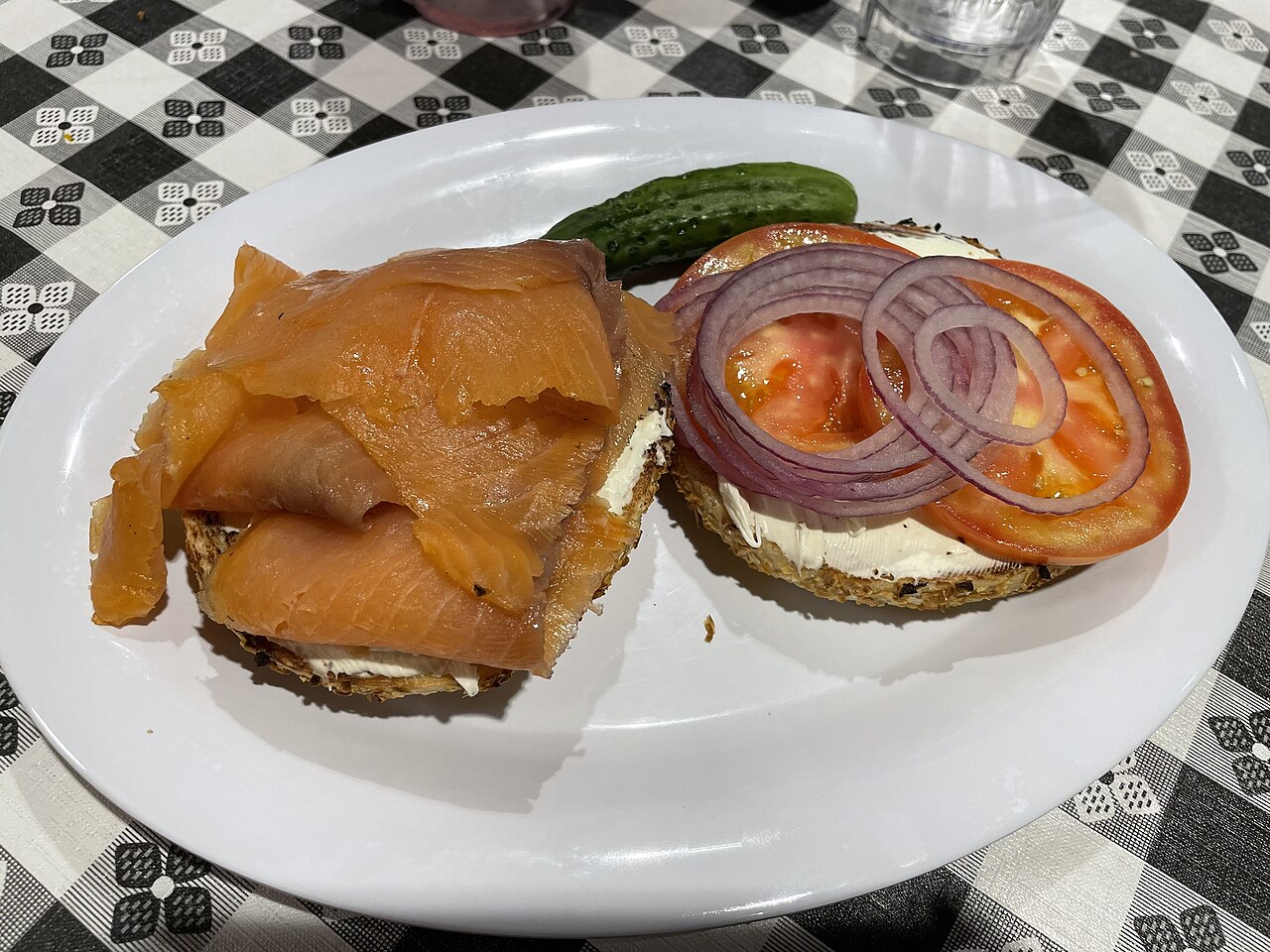
What Does Kosher Style Mean?
Kosher style is a menu label, not a certification. My Jewish Learning says this food falls short of the standard for strictly kosher food, and beyond that the meaning is ambiguous. Some people mean dishes Jews traditionally eat, usually Jews of Eastern European descent, such as bagels with lox and deli sandwiches, made without strictly kosher ingredients. Others mean food whose ingredients “in theory could be kosher but have not in fact been certified kosher.” Under that definition, My Jewish Learning would count a chicken noodle soup with no dairy as kosher style, even if a non-kosher slaughterer killed the chicken. Some use it for food with no shellfish or pork, even when meat and dairy mix. A few use it for any food Jews like to eat, pork hot dogs included.
Notice what every version shares. No agency has certified the food. Kosher food follows the Jewish dietary laws, which My Jewish Learning describes as based on biblical food prohibitions, rabbinic expansions, and long-standing custom. From the label, you learn the style of the food and nothing about its kashrut.
Chabad.org agrees. Rabbi Menachem Posner on Chabad.org, the site’s managing editor, writes that many of the most famous “Jewish style” or even so-called “kosher style” delis in America are not, in fact, kosher. If you want to eat at a deli, he says to check for a recognized kosher certification on the wall.
Is Kosher Style Food Actually Kosher?
No, kosher style food is not kosher unless a reliable agency certifies the kitchen. My Jewish Learning says such food “does not achieve the same standard as strictly kosher food.” A restaurant can follow some of the rules and still fail the rest.
The best-known example is the cheeseburger. No one can call a cheeseburger kosher style under the first two meanings, because meat and dairy can’t share a strictly kosher meal. A pastrami sandwich fits the label easily, since the dish is traditional. It still needs kosher meat, and from the label you learn nothing about the meat, the bread, or the pans.
Why Almost Kosher Is Not Kosher
Rabbi Eli Gersten of the Orthodox Union wrote that “there is no such thing as ‘almost’ kosher.” He wrote it for Jewish Action in 2017 about vegetarian Indian restaurants with an unreliable hechsher, places some people call “almost” kosher. You can apply his reasons to a kosher style deli, too:
- Ingredients. Wine and wine vinegar in a non-kosher restaurant are most likely not kosher. He warns that if nobody inspects a restaurant regularly, you should expect non-kosher ingredients in the food.
- Processed foods. He says you can’t tell whether a product is kosher from its ingredient label, because the manufacturer may make sauces with meat and cheese on the same line.
- Vegetables. Leafy vegetables need a careful check for insects, and he says restaurants without regular visits from a mashgiach won’t take the time.
- Cheese. He writes that cheese isn’t kosher unless Jews take part in making it or supervise it, even when every ingredient is kosher.
- Cookware. If nobody kashered the pots, pans, and cooking utensils, the food prepared in them isn’t kosher either.
- Cooked food. He says some cooked foods need Jewish participation in the cooking (bishul akum). Without a mashgiach who lights the fires each morning, or a system to keep them lit, he says you must assume the kitchen broke that rule.
- Appearances. Diners who see you eat there may conclude they can eat there too. Halacha calls this maaris ayin, and he says the concern holds even when you order something kosher.
His conclusion is short. “It should be clear that ‘almost kosher’ is not really kosher.”
Kosher Style vs Kosher Certified: A Quick Comparison
Use this table to compare what each label promises. We summarized it from the sources linked in this post.
| Question | Kosher style | Kosher certified |
|---|---|---|
| Who checks the kitchen? | No agency. The owner decides what the label means. | A mashgiach under a rabbi or agency, such as the OU, Star-K, or cRc. |
| Ingredients | Not verified. They may be kosher, or not. | Supervisors check deliveries for a hechsher. |
| Meat and dairy | May mix, depending on the menu. | Kept separate under supervision. |
| Fish and seafood | May include shellfish. | Kosher fish only. |
| Your assurance | The style of the cooking. | The agency’s name on a certificate. |
What a Mashgiach Actually Does
Certification means someone watches the kitchen. The OU Kosher staff write that a food service mashgiach “must be fully aware of everything that is going on in the kitchen” and should check every delivery as it comes off the truck, if possible. A restaurant without certification has no one in that job.
The OU also holds a firm line on who qualifies. In a position paper, Rabbi Yaakov Luban, the OU’s Executive Rabbinic Coordinator, wrote that “as a matter of policy, the OU does not endorse restaurants or caterers unless there is a Mashgiach present who does not have a financial interest in the facility.” He added that relying on a Shomer Shabbos owner to self-supervise “does not constitute effective hashgocha or supervision.” A friendly owner who says everything is kosher doesn’t meet that bar. For the longer story, read our guide on what a mashgiach does.
What About Fish at the Deli?
Fish at a deli can be a kosher species on a plate that is not kosher. Take the lox on a bagel. The Torah gives the test for fish in Leviticus 11:9: it must have fins and scales. Salmon passes, and we explain why on our is salmon kosher page. A kitchen that cooks it in unchecked pans, or dresses it with an unchecked sauce, can still fail the kashrut standard. Gersten lists those risks above.
That is why fish is a special case. On a whole fresh fish you can see the fins and scales, so you can verify the species yourself. Once a kitchen slices, smokes, or cures the fish, you often can’t see the skin anymore, so you rely on the supervision. We cover this in our post on whether fish needs a hechsher. Herring, whitefish, and salmon are staples of the deli case. Check each one with the kosher fish list before you order, and check the hechsher on the package or the restaurant wall.
How to Check a Deli’s Kosher Status
You can ask a few direct questions. My Jewish Learning says that because the term is ambiguous, it is always a good idea to ask. Ask these questions to get a straight answer:
- Which agency issued the kosher certificate on the wall, and is the certificate current?
- Does the certificate cover meat, dairy, or both?
- Is a mashgiach on site, and does the mashgiach work for the agency instead of the owner?
- Does the menu mix meat and dairy, offer pareve dishes, or serve any shellfish?
- Do you buy sealed products with a hechsher, such as the bread, the meat, and the sauces?
If the staff can’t name an agency, treat the answer as a no. If you’re unsure whether you can trust a certificate, ask your own rabbi. KosherFish is a lookup tool, and we don’t rule on what you can eat.
Why Restaurants Use the Phrase
My Jewish Learning says the term grew popular in early 20th-century America. Jews could eat outside their homes, in non-Jewish settings, and still keep a connection to the laws of kashrut. Today, restaurants and caterers use it for traditional Ashkenazic dishes made without supervision from ingredients that would normally be acceptable, and sometimes for traditional dishes with forbidden ingredients.
A deli that owns the phrase helps you. A restaurant that writes kosher style and hopes you’ll read it as kosher doesn’t. The difference is whether the owner will tell you, when you ask, that the kitchen has no supervision.
Can You Make a Deli Sandwich Kosher at Home?
Yes, you can. Rabbi Menachem Posner on Chabad.org says to use only kosher-certified meat, bread, and condiments when you build a deli sandwich at home, and to leave out the cheese, because meat and dairy can’t combine. At home, you control the supervision. At a restaurant, someone else runs the kitchen, and only a mashgiach can vouch for the work.
That is the real divide. A style is something you can copy. A hechsher is something an agency has to give you after it has checked the kitchen.
Check Any Fish with KosherFish
When you can’t verify the kitchen, you can at least verify the fish. You can look up salmon, herring, whitefish, and 290+ other species on the KosherFish list or in the lookup tool. On the go, you can get the same answer at the counter in the iOS app or the Android app. You can settle the species question yourself. Only a mashgiach can settle the kitchen question.
Frequently Asked Questions
What does kosher style mean?
Kosher style means food in the Jewish deli tradition that is not certified kosher. My Jewish Learning says the term is ambiguous and covers traditional Eastern European dishes, food whose ingredients could be kosher but aren’t certified, and looser uses. From that label, you learn nothing about supervision.
Is kosher style the same as kosher?
No. Kosher means a reliable agency or rabbi supervises the kitchen and ingredients. Kosher style describes the cooking tradition. My Jewish Learning says such food doesn’t meet the standard of strictly kosher food, and Chabad.org says many famous kosher style delis in America are not kosher.
Can you eat at a kosher style restaurant if you keep kosher?
Ask your own rabbi first. The OU’s Rabbi Eli Gersten wrote that there is no such thing as almost kosher. He listed unchecked ingredients, insects in produce, unkashered cookware, and the way other diners read your choice (maaris ayin). Without supervision, you can’t verify any of those.
Is a kosher style deli kosher?
Not by that label alone. Rabbi Menachem Posner on Chabad.org says to check for a recognized kosher certification on the wall. If you see no certificate from an agency such as the OU, Star-K, or cRc, you can’t treat the deli’s food as kosher.
Is lox kosher?
Salmon is a kosher species because it has fins and scales, as Leviticus 11:9 requires. Lox is a processed form, so a kosher-keeping customer looks for a hechsher on the package or the restaurant. Without certification, you can’t confirm the equipment or the other foods in the kitchen.
Does the OU certify restaurants?
The OU’s stated policy is that it doesn’t endorse restaurants or caterers unless a mashgiach is present who has no financial interest in the facility. Rabbi Yaakov Luban wrote that in a position paper presented in 2007. An owner who self-supervises doesn’t count as effective supervision.
How can I tell if a restaurant is really kosher?
Ask for the certificate and read the agency’s name. Confirm the certificate is current, the mashgiach isn’t the owner, and the menu doesn’t mix meat and dairy. If you can’t confirm those, treat the place as not kosher and ask your own rabbi.
The Bottom Line
Kosher style is a flavor, and kosher is a standard. If a restaurant has a current certificate from a reliable agency and a mashgiach who answers to that agency, you have the kind of supervision the OU requires before it endorses a restaurant. Ask your own rabbi if you’re unsure about the agency. If a restaurant only uses that label on the menu, you get a deli tradition and no supervision. Browse the kosher fish list, look up any species in the KosherFish lookup tool, or keep the iOS or Android app handy. For more background, read our guides to kosher symbols, what a hechsher is, and how to keep kosher.