
Chalav Yisrael is milk produced under the supervision of a Jewish mashgiach, present from the time of milking through bottling, to confirm the milk came only from a kosher animal. You’ll often see it spelled cholov yisroel in OU and Star-K literature. Both spellings mean the same thing. Unsupervised milk, produced without a Jew present, is called chalav akum. This is one of the oldest kosher supervision rules still active today. It splits into two camps in modern practice. Some people use only chalav Yisrael. Others rely on a 20th-century ruling that treats regular government-regulated milk in the United States the same way. If you already check a hechsher on fish before you buy it, this is the dairy version of that same question.
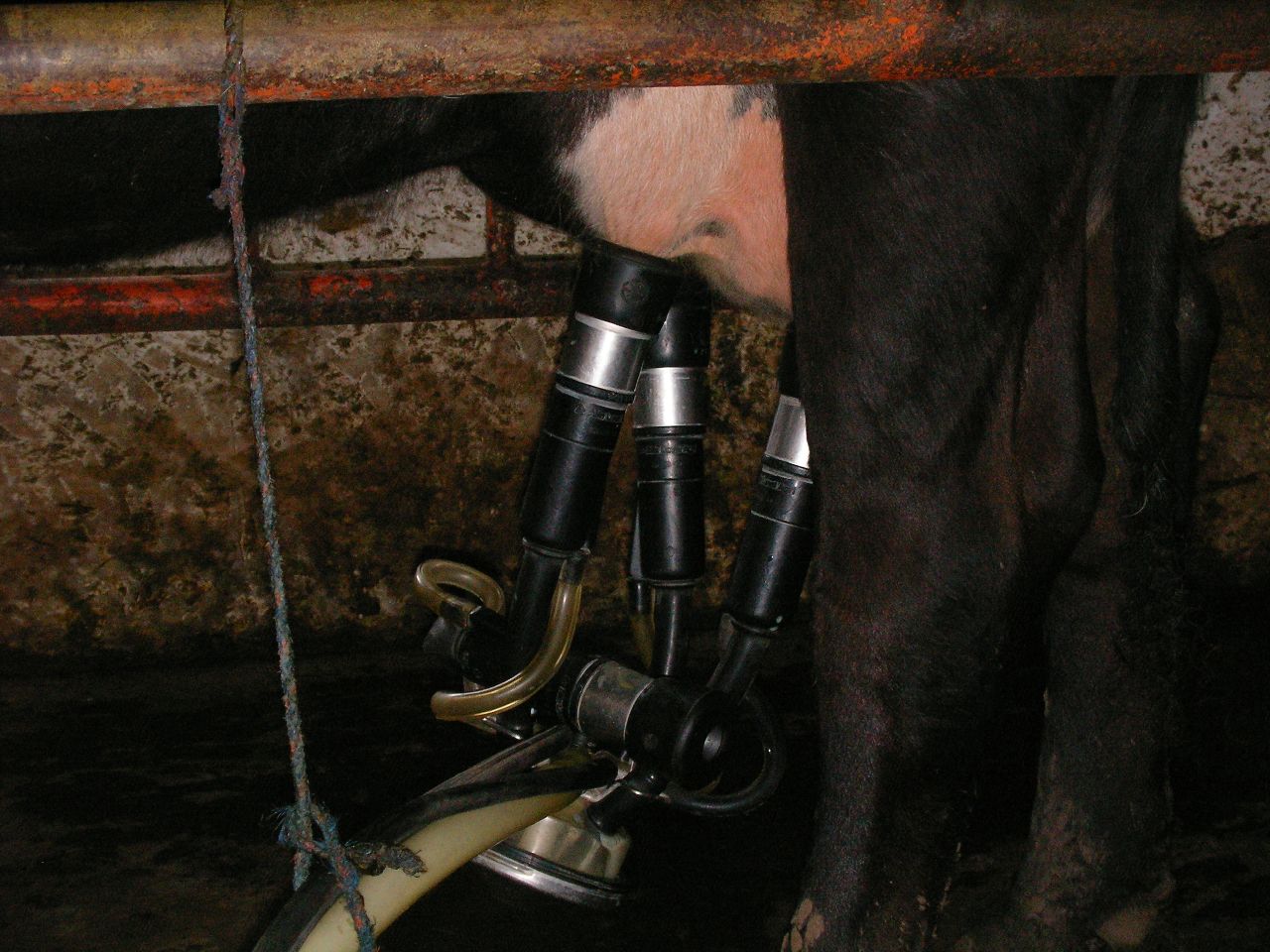
Why Chalav Yisrael Exists
The rule is a real piece of kashrut law: it goes back to the Talmud, tractate Avodah Zarah 35b, and is codified in the Shulchan Aruch (Yoreh Deah 115:1). In the ancient Middle East, farmers often kept small, mixed herds, cows and sheep next to camels and donkeys. A customer buying milk at market had no way to check what was actually in the jug. The Sages worried that milk from non-kosher animals (camel, donkey, mare) could get quietly mixed into kosher cow’s or sheep’s milk. A non-Jew selling at market could pass the mixed milk off as the real thing. So Chazal issued a gezeirah, a rabbinic decree, requiring a Jew to be present at the milking. That’s chalav Yisrael: milk a Jew watched being produced, so there’s no question what animal it came from.
The supervision doesn’t need to be constant staring at the udder. Per the Shulchan Aruch, a mashgiach standing where he could walk in at any moment is enough. The possibility of getting caught is what deters the fraud in the first place. That detail matters, because it’s the same logic Rav Moshe Feinstein later stretched to cover an entire country’s milk supply.
Rav Moshe Feinstein’s Ruling on Chalav Stam
In the mid-1900s, Rav Moshe Feinstein, one of the most relied-upon halachic authorities of his era, addressed a practical problem: almost no American dairy had a mashgiach at the barn. In his responsa (Igros Moshe, Yoreh Deah 1:47-49, and again in 2:35), he made a ruling that changed American kosher practice. Ordinary commercial milk sold in the United States, and in other countries with comparably strict government dairy regulation, can be treated as the halachic equivalent of chalav Yisrael. He called it chalav ha-companies. It’s commonly known today as chalav stam.
His reasoning had two parts. First, federal law bars labeling anything “milk” unless it’s cow’s milk. USDA inspectors check dairy plants routinely. A company caught mixing in a cheaper, non-kosher milk faces real legal and financial consequences. That deterrent, he argued, does the same job a mashgiach’s presence does. Second, he applied a halachic concept called anan sahadei, roughly “we are all witnesses.” A fact this well established by outside verification counts as if it had been directly observed. Government inspection makes it a known fact that US milk is unadulterated cow’s milk. Rav Moshe held that no mashgiach needs to physically stand in the barn to reach the same conclusion.
Here’s the detail people miss: Rav Moshe permitted this leniency for others, but by his own account he personally kept drinking only bona fide chalav Yisrael. That’s not a contradiction. Rabbis rule this way often in kashrut law. A posek can permit something for the community while personally holding to a stricter standard. It’s a sign of how seriously even the author of the leniency treated the underlying concern.
How the OU, Star-K, and cRc Label It Today
This is the part that actually matters at the grocery store. The Orthodox Union (OU) states plainly that its general dairy certification “follows the opinion of Rav Moshe Feinstein… that government inspection of dairies is equivalent to a Mashgiach’s supervision,” which means standard OU-D milk and cheese is certified kosher without being chalav Yisrael. The OU is direct about the catch. “Not all Poskim accept the position of Rav Moshe,” it states, “and those who follow the more stringent opinion should only use OU products which are specifically labeled Cholov Yisroel.” A plain OU-D symbol on a dairy product does not by itself mean chalav Yisrael. The label has to say so, in words, or carry a separate Cholov Yisroel or Mehadrin marking.
Star-K runs the same split. Its consumer materials define Cholov Yisroel the traditional way, a mashgiach present from milking to bottling. Where a Star-K product is chalav Yisrael, the label says so. The Chicago Rabbinical Council (cRc) publishes its own explainer on the same distinction for its certified dairy products. All three agencies certify plenty of chalav stam products under standard hashgacha and a separate, smaller line of supervised-milk products for households that want it. The rule of thumb: don’t assume, read the label.
Who Still Uses Chalav Yisrael Only, and Why
Chassidic communities, including Chabad-Lubavitch, are the most visible group that sticks to chalav Yisrael exclusively, and Chabad.org’s own kashrut materials promote it as the standard practice, not just an option. The reasoning tracks Rav Moshe’s personal practice. The leniency is halachically defensible. But it’s still a leniency, built to solve a practical access problem rather than to replace the original, stricter rule. Many US cities now have real supply of supervised milk products through the major agencies. A household that can reliably find them has less reason to lean on the government-inspection argument at all. This is a stringency (chumra), not a case where the authorities disagree about what’s actually kosher. Chalav stam is broadly accepted as kosher by mainstream Orthodox authorities. The dispute is over which standard to hold yourself to, not whether the lenient position is valid.
| Milk Type | Supervision | Who Uses It |
|---|---|---|
| Chalav Yisrael | A mashgiach is present from milking through bottling | Chassidic and Chabad households, and anyone following the stricter opinion |
| Chalav Stam | No mashgiach on-site, relies on Rav Moshe Feinstein’s government-inspection ruling | Most US kosher-observant households, per mainstream OU and Star-K policy |
| Chalav Akum | No Jewish or verified government supervision at all | ⚠️ Not treated as kosher by any of the positions above |
Reading a Dairy Label the Right Way
If you’re trying to keep chalav Yisrael, check for the words “Cholov Yisroel” printed near the kosher symbol, not just the symbol itself. If you’re comfortable with chalav stam, any standard OU-D, Star-K, cRc, or other reliable dairy hechsher on regular commercial milk and cheese is enough. Either way, the symbol alone answers “is this kosher,” but only the words next to it answer whether it meets the stricter standard. That habit is worth building for any hechsher, whether it’s on a milk carton or a package of fish fillets: read what it actually says, not just whether a symbol is present. If a label is unclear or a product is genuinely in doubt, ask your rabbi or contact the certifying agency directly. KosherFish is a lookup and information tool, not a posek.
Eating Out With Kosher Dairy
This is where the two standards actually collide in real life. A kosher-certified restaurant, bakery, or pizza shop almost always uses regular commercial dairy under a standard hechsher. That’s chalav stam, unless the menu or the posted certificate says otherwise. That’s fine for the majority of kosher consumers, since chalav stam carries a valid kosher certification under mainstream agency policy. But if your household keeps chalav Yisrael only, you can’t assume a kosher symbol on the door covers you. Ask directly, “is your dairy chalav Yisrael,” before you order the milkshake or the cheese pizza. Ice cream shops and coffee bars are the most common trip-up. The milk, cream, and any dairy syrups usually come from a large commercial supplier by default.
The same question applies to packaged snacks with a “may contain milk” or dairy hechsher at the grocery store. It applies to any recipe that calls for butter, cream, or milk in a kosher kitchen too. A little label-reading up front saves a return trip.
Check Any Fish with KosherFish
Fish doesn’t carry a chalav Yisrael question since it’s pareve, neither meat nor dairy. But the same “read the label, don’t just trust the symbol” habit applies to seafood too. Whole fresh fish with its fins and scales visible generally doesn’t need certification. Processed, smoked, or packaged fish can, for the same reason dairy does. Once you can’t see the source, you need someone who checked it. You can look up any of 291 species on the KosherFish lookup tool or browse the full kosher fish list, and check a fish on the go with the iOS app or Android app.
Frequently Asked Questions
What is chalav Yisrael?
Chalav Yisrael is milk produced under the watch of a Jewish mashgiach, present from the time of milking through bottling, to confirm the milk came only from a kosher animal. The rule dates to the Talmud (Avodah Zarah 35b) and the Shulchan Aruch (Yoreh Deah 115:1), which required Jewish supervision to prevent non-kosher animal milk from being secretly mixed in and sold as kosher.
What is chalav stam?
Chalav stam is ordinary commercial milk produced without a mashgiach on-site, relying instead on Rav Moshe Feinstein’s ruling (Igros Moshe, Yoreh Deah 1:47-49) that strict US government dairy inspection makes it a known fact that the milk is unadulterated cow’s milk. Most mainstream US kosher agencies, including the OU and Star-K, treat chalav stam as kosher for general certification.
Does an OU symbol on milk mean it’s chalav Yisrael?
No. A plain OU-D symbol certifies the product as kosher dairy but does not by itself mean chalav Yisrael. The OU states that products carry that status only when the label specifically says so, such as “OU-D Cholov Yisroel.” Regular OU-D milk relies on Rav Moshe Feinstein’s chalav stam ruling instead.
Do Chassidic Jews only drink chalav Yisrael milk?
Many Chassidic communities, including Chabad-Lubavitch, use chalav Yisrael exclusively as standard practice, not as an exception. This tracks Rav Moshe Feinstein’s own personal habit: he ruled that chalav stam was permitted for others, but by his own account he continued drinking only fully supervised milk himself.
Is this a Torah law or a rabbinic rule?
It’s a rabbinic decree (gezeirah), not a Torah-level (d’oraita) prohibition. Chazal enacted it because farmers in the ancient Middle East often kept mixed herds, making it easy to blend non-kosher animal milk into kosher milk sold at market. The concern is fraud and identification, not that regular cow’s milk is inherently non-kosher.
Does the rule apply to cheese too?
Cheese generally requires kosher supervision of its own regardless of the milk source, since rennet and other ingredients need checking. Whether Rav Moshe Feinstein’s chalav stam leniency extends to cheese the same way it does to fluid milk is a separately discussed question among poskim, so check the label’s specific wording rather than assuming it matches the milk rule.
Is chalav stam considered kosher by mainstream authorities?
Yes. Chalav stam is broadly accepted as kosher by mainstream Orthodox authorities, including the OU and Star-K, based on Rav Moshe Feinstein’s ruling. The disagreement among poskim isn’t about whether chalav stam is valid, it’s about which standard an individual or community should choose to follow.
The Bottom Line
Chalav Yisrael is milk supervised by a Jew from milking through bottling, the original safeguard against non-kosher animal milk getting mixed into the kosher supply. Rav Moshe Feinstein’s ruling on chalav stam lets most US kosher households rely on government-inspected commercial milk instead, a leniency the OU and Star-K both build into their standard certification, while Chassidic communities and anyone following the stricter opinion stick to chalav Yisrael specifically labeled as such. Neither position is wrong. They’re two accepted standards, and the only real mistake is assuming a plain kosher symbol tells you which one you’re getting. Read the label.
Sources for the rulings above: the OU (oukosher.org), Star-K (star-k.org), the Chicago Rabbinical Council (crckosher.org), and Chabad.org, all cited by name throughout this guide. For more on how kosher certification works, see Kosher Symbols Explained, What Does OU Kosher Mean?, and Does Fish Need a Hechsher?. Checking a fish is faster: use the KosherFish lookup tool, browse the full kosher fish list, or grab the iOS or Android app.