Haddock is kosher. It has fins and the finely edged, easily removable scales the Torah requires in Leviticus 11:9-12, and both the Orthodox Union (OU) and the Chicago Rabbinical Council (cRc) list haddock on their published kosher fish rosters. You can look up haddock and 290 other species with the KosherFish tool in about ten seconds, but the short version holds up on its own: haddock is one of the safest, most straightforward fish at the counter for anyone keeping kosher.
Why Haddock Is Kosher: The Fins and Scales Rule
The Torah sets one test for fish, stated twice: Leviticus 11:9-12 and Deuteronomy 14:9-10. A fish is kosher only if it has both fins and scales, the two-part fins and scales rule that decides every case. The scales also have to be the kind you can scrape off without tearing the skin underneath. Shellfish and other non-kosher seafood, like lobster, shrimp, and crab, fail this test outright, since they have neither fins nor scales. Haddock passes on both counts. It swims with true fins. Its body is covered in small, cycloid scales, the smooth, overlapping kind that lift away cleanly.
That’s a different structure from the embedded plates on a sturgeon. It’s also different from the tooth-like denticles on a shark. Both fail the test even though they technically have something on their skin. Haddock doesn’t run into that ambiguity. Is haddock kosher by the plain reading of the rule? It looks like a textbook case because, biologically, it is one.
Haddock belongs to the Gadidae family, the cod family, alongside Atlantic cod, pollock, whiting, and hake. Every member of that family shares the same fin-and-scale profile, and every one of them is kosher. That family resemblance matters later, when we get to how haddock gets sold and relabeled at the counter.
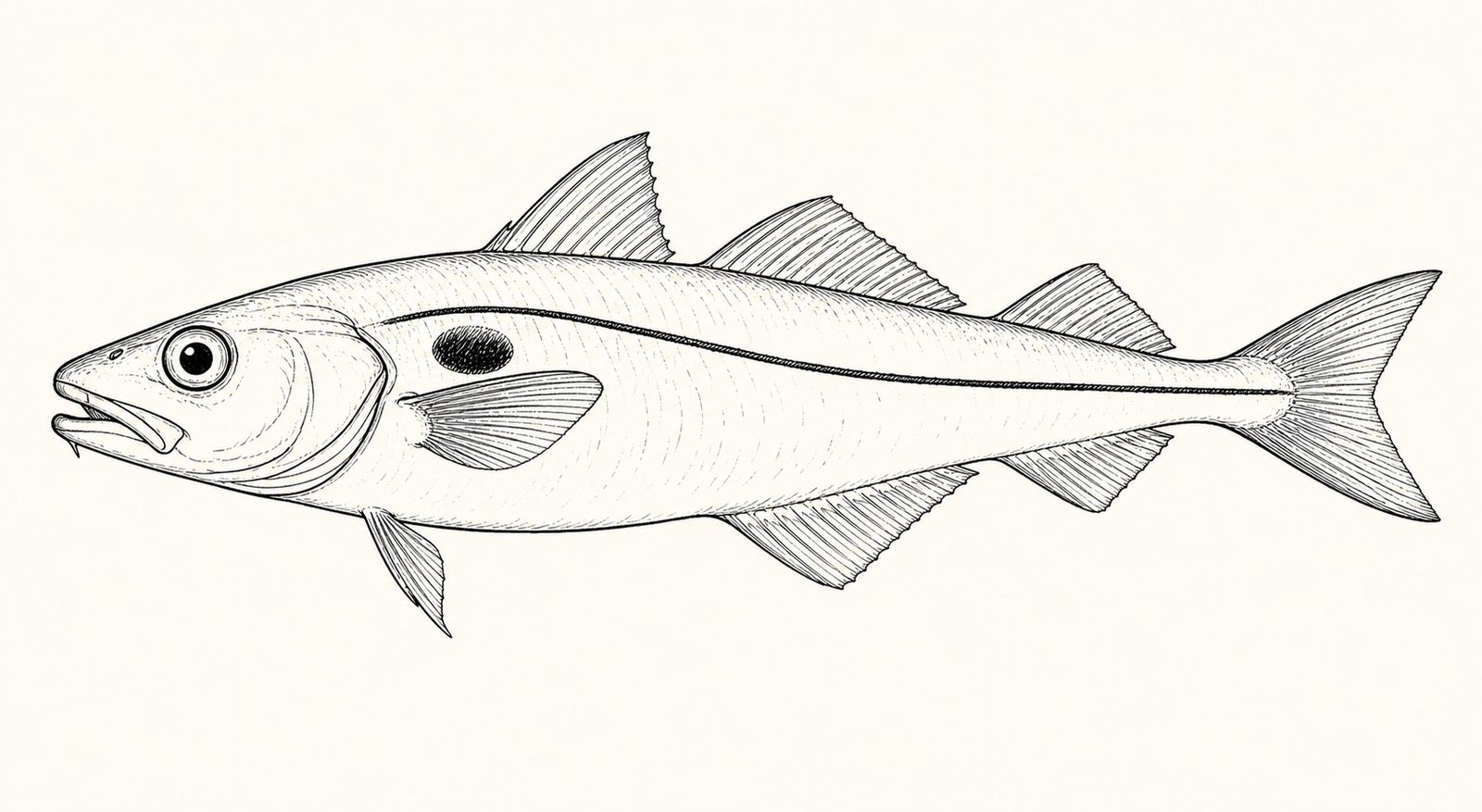
Biologically, NOAA Fisheries lists haddock (Melanogrammus aeglefinus) as a saltwater, bottom-dwelling groundfish of the North Atlantic. It’s caught commercially on Georges Bank and in the Gulf of Maine on the US side, and off Iceland, Norway, and the North Sea on the other. You can pick one out on ice by two marks. Look for a single black lateral line running the length of its body, and a dark, thumb-sized smudge above the pectoral fin that fishermen call the “thumbprint,” or in folklore, the mark left by St. Peter. Neither marking has anything to do with the kosher test. What matters is underneath them: the small, smooth, overlapping scales that meet the standard in Leviticus 11:9-12.
Who Says Haddock Is Kosher: The OU and the cRc
The biology supports the ruling, but the ruling itself comes from a recognized authority, not from reasoning about scales on your own. Haddock is widely considered kosher precisely because a recognized authority says so, not because a shopper worked it out alone. The Orthodox Union, the largest kosher certifier in the world, includes haddock on its kosher fish list. The Chicago Rabbinical Council publishes its own well-known fish list and lists haddock there too. Neither authority treats haddock as a borderline case. Swordfish carries a documented historical dispute among poskim. Chilean sea bass trips people up over its name. Haddock has neither problem, so its kosher status isn’t contested. It sits in the same uncontroversial bucket as cod and flounder: a plain, garden-variety kosher fish.
That said, whether haddock is kosher as a species is a different question than whether every product labeled haddock is certified. It doesn’t automatically certify every product with the word haddock on the label, which is the next thing worth getting straight.
Haddock, Cod, and “Scrod”: The Market-Name Mix-Up
Fish counters love a nickname, and haddock, a common whitefish on the counter, has a famous one: scrod. Scrod isn’t a species. It’s a New England market term for a young, small whitefish. Depending on the boat and the day, it might be young haddock or young cod. Both are kosher. Both are Gadidae. A plate of scrod doesn’t put your kashrut at risk either way. But it’s a useful example of a trap the OU and cRc both warn about. A name on a menu or a label doesn’t always tell you the actual species, and you can’t apply the fins-and-scales rule to a fish you can’t identify. If a name is unfamiliar or vague, ask what it actually is before you assume.
The reverse mix-up is worth knowing too. A whole, fresh haddock still has its head, skin, and scales intact, so you (or your fishmonger) can confirm the species by sight. Once it’s filleted, breaded, smoked, or turned into fish sticks, that visual check disappears. You end up relying on the label and the supply chain instead of your own eyes. Haddock is also the classic choice behind traditional British fish and chips, often interchangeable with cod depending on the shop and the season. Both are kosher, so the swap doesn’t change the kashrut answer. It’s still worth knowing that a “fish and chips” menu item is really just haddock or cod under a batter, not a mystery fish.
| Fish | Kosher? | Why |
|---|---|---|
| Haddock | ✅ Yes | Gadidae family, fins and easily removable cycloid scales (OU and cRc both list it) |
| Cod | ✅ Yes | Same family as haddock, same fin-and-scale profile (OU and cRc list it) |
| Pollock | ✅ Yes | Also Gadidae, the fish behind most fish sticks and imitation crab |
| “Scrod” | ✅ Yes, confirm the species | A market name for young haddock or young cod, not a species on its own |
| Catfish | ❌ No | No scales at all, fails the Leviticus 11:9-12 test entirely |
Does Smoked Haddock Need a Hechsher?
Whole fresh haddock generally doesn’t need a hechsher (a kosher certification symbol), because the fins and scales are still visible and the species is verifiable at a glance. Most people keeping kosher rely on that visual check at the fish counter rather than looking for a symbol on a fresh whole fish.
Processed haddock is a different question, and this is where a lot of people get caught off guard. Smoked haddock, sold in Britain as finnan haddie and common on Ashkenazi brunch tables here as well, loses its skin and scales in the smoking process. You can no longer confirm the species yourself. The same goes for breaded fillets, fish sticks, canned haddock, and haddock folded into a prepared dish.
Once the fish is processed, you’re trusting the label, the equipment it was made on, and any additives in the mix, none of which you can verify by looking. That’s exactly when a reliable hechsher starts to matter. Look for a recognized symbol (the OU’s circled U, the cRc’s symbol, Star-K, OK, or Kof-K) on smoked, breaded, or packaged haddock products. If a product doesn’t carry one, ask your own rabbi or check with a certification agency before you buy.
A practical rule of thumb at the counter: if you can still see the skin and the scales, you can verify haddock yourself. The moment a fish is skinned, filleted, smoked, breaded, or combined into a mixed product, that visual check is gone, and the certification symbol is what replaces it.
Haddock for Shabbat and the Break-Fast Table
Haddock is pareve, meaning it’s neither meat nor dairy, so it fits into either a meat meal or a dairy one. Many communities do keep a custom of not eating fish and meat off the same plate or in the same course, so it’s still worth serving haddock as its own course rather than plating it alongside a meat dish, even though it’s pareve by status.
Mild, flaky whitefish like haddock show up often at the Yom Kippur break-fast table and the Shabbat brunch spread, usually smoked and served alongside bagels, cream cheese, and the rest of an Ashkenazi fish board. If that’s the plan, that’s exactly the processed, smoked form covered above, so check for a certification symbol on the package rather than assuming a fresh-fish rule still applies.
Check Any Fish with KosherFish
The question “is haddock kosher” settles cleanly on its own, but the fish counter rarely sticks to one name. A single species verdict is useful, but it’s not the whole trip. If you’re standing there wondering about scrod, hake, or whatever’s next to the haddock on ice, you can look up haddock and 290 other species on the full kosher fish list. Or search any name that comes up on the KosherFish homepage. Want the answer without pulling out a laptop at the market? The iOS app and the Android app put the same lookup in your pocket, so you can check a fish before it hits your cart.
Frequently Asked Questions
Is haddock kosher?
Yes. Haddock has fins and easily removable cycloid scales, which is the Torah’s test in Leviticus 11:9-12 and Deuteronomy 14:9-10. Both the Orthodox Union and the Chicago Rabbinical Council list haddock on their kosher fish rosters, and the species isn’t contested the way swordfish or Chilean sea bass are. A whole fresh haddock is kosher and easy to verify by sight.
Is smoked haddock kosher?
Smoked haddock is kosher as a species, but the smoking process removes the skin and scales you’d normally use to confirm the fish yourself, and it can introduce shared equipment or additives. Look for a recognized kosher symbol, like the OU, cRc, Star-K, OK, or Kof-K, on smoked haddock (finnan haddie) before you buy it, rather than assuming a fresh-fish rule carries over.
What family of fish is haddock?
Haddock belongs to Gadidae, the cod family, alongside Atlantic cod, pollock, whiting, and hake. Every member of that family has fins and removable scales, and every one is kosher. That shared family trait is why haddock, cod, and pollock all appear together on the OU and cRc kosher fish lists without any of them being a contested or borderline case.
Is scrod the same fish as haddock?
Not exactly. Scrod is a New England market name for a young, small whitefish, and it can mean young haddock or young cod depending on the catch. Both are kosher, so scrod is safe either way, but the name itself doesn’t tell you the species. If a label or menu uses a vague market name, ask what fish it actually is before you rely on it.
Does haddock need a hechsher?
Fresh whole haddock generally doesn’t, since the fins and scales are still visible and the species is verifiable at a glance. Processed haddock, like smoked, breaded, canned, or pre-made dishes, does need a reliable certification, because you can no longer confirm the species or the equipment yourself once it’s been altered.
Is haddock pareve?
Haddock, like all kosher fish, is pareve, meaning it counts as neither meat nor dairy and can be served alongside either. Many communities still keep a custom of not eating fish and meat in the same course or off the same plate, so haddock is usually served as its own course even at a meat meal.
Why are some fish not kosher even though they have fins?
Fins alone aren’t enough. A fish also needs scales that can be peeled off without tearing the skin, and some fish fail that second half of the test. Sharks have placoid scales (denticles) fused to the skin, sturgeon have embedded ganoid scales, and catfish have no scales at all, so none of them are kosher despite having fins.
The Bottom Line
Is haddock kosher, in the end? Yes. It has fins and the removable scales the Torah requires. The OU and cRc both list it without qualification, and it isn’t a contested species like swordfish or a name-confusion risk like Chilean sea bass. The one thing to watch is processing. Fresh whole haddock you can verify yourself, but smoked, breaded, or packaged haddock needs a real certification symbol, not just an assumption.
Check the fish’s haddock species page for the full profile, browse the kosher fish list for haddock’s 290 neighbors, and read is cod kosher for haddock’s closest relative at the counter. For the fins-and-scales rule from the ground up, see what makes a fish kosher. For more on when a hechsher matters, read does fish need a hechsher. Or skip the reading and just search the fish in front of you on the KosherFish homepage or the iOS and Android apps.