Is snook kosher? Yes. Snook is a kosher fish, because it has fins and large scales that lift off the skin, and the Orthodox Union (OU) kosher fish list names the snook family. The catch is the cut. A skinless snook fillet has lost the proof, so buy it only under reliable supervision. You can check snook and 290+ other fish on the full kosher fish list.
The short answer on whether snook is kosher
One test applies to every sea creature in the Torah. Leviticus 11:9-12 and Deuteronomy 14:9-10 say a fish is kosher if it has both fins and scales. Both parts fit snook. The OU kosher fish list, which Chabad.org reprints with permission, includes the entry “Snooks (Family Centropomidae) including: Snooks or rabalos (Centropomus species).” A second line sends anyone who looks up “Rabalo” to the same snook entry.
The OU lists the whole genus, so the verdict covers the common snook and its close relatives wherever they live. You can read the same verdict on our snook page. We could not find a separate snook line on the cRc or Star-K pages we checked, so the OU list is the authority we cite here. If you want a second opinion, ask your own rabbi.
Why snook passes the fins and scales test
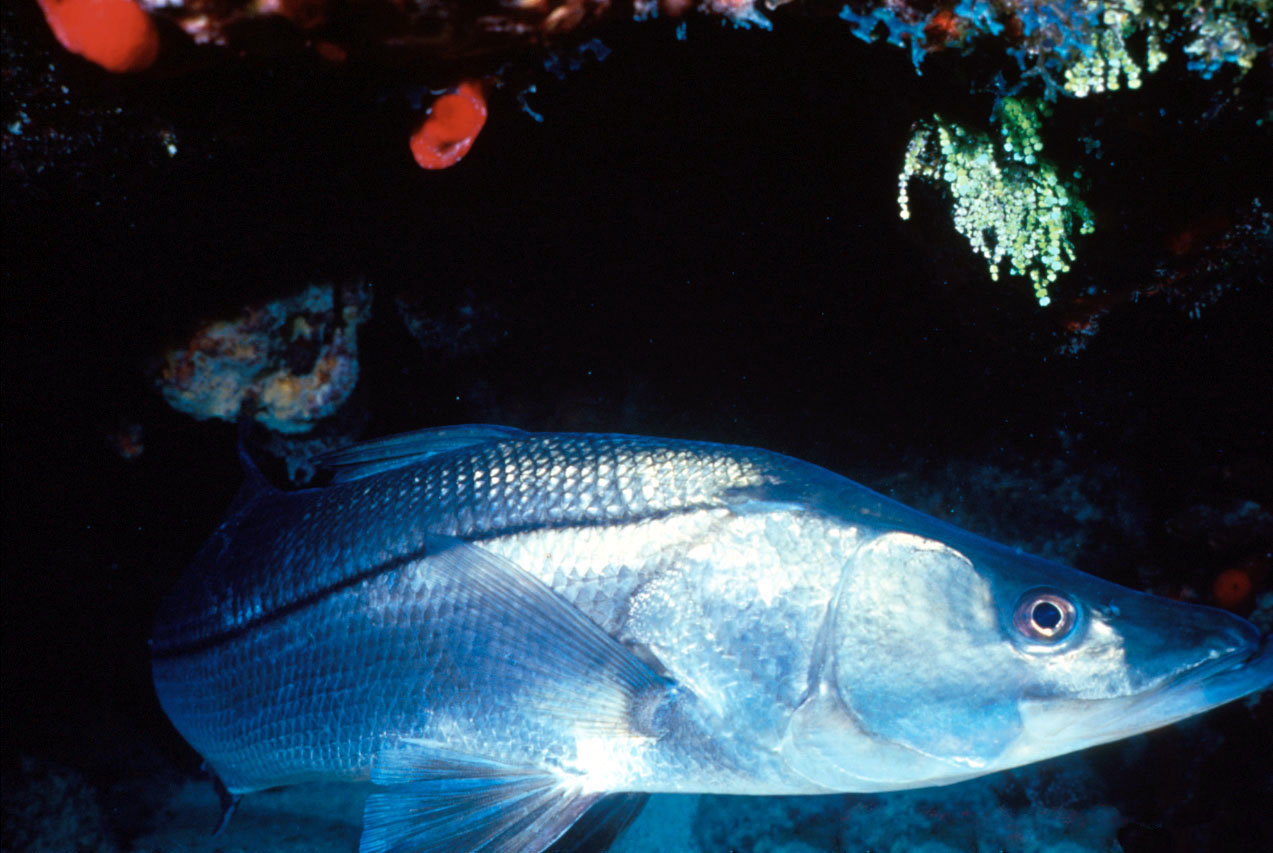
Anglers prize the snook as a game fish known for its fight. The common snook (Centropomus undecimalis) is a drab, silvery fish with one distinctive black lateral line down each side. Its range covers the tropical western Atlantic, from the North Carolina coast to Brazil, including the Gulf of Mexico and the Caribbean. It lives in shallow coastal waters, estuaries, and lagoons, and it often swims into fresh water. A common snook can reach 140 cm (4.6 feet), and the IGFA all-tackle record is 24.32 kg (53 lb 10 oz), caught in Costa Rica. Earlier record fish came from Fort Myers, Florida, and the Gatun Spillway in Panama.
The scales matter most. One North Carolina fish reference calls the scales of this species moderate to large and ctenoid, which means rough to the touch. FishBase counts 67 to 72 pored scales along the lateral line to the base of the tail. Those big, visible scales are the opposite of the tiny embedded kind, so you can run the check by hand in seconds.
Halacha defines scales by how they come off, not by how they look. The OU says the Torah word kaskeses means scales that you can remove without tearing the skin, a standard it traces to the Ramban’s Torah commentary. The OU also says all you need to confirm is the scales, because the Talmud (Chullin 66b) holds that a fish with scales always has fins. We cover the rule in plain words in our guide on what makes a fish kosher.
Snook is a whole genus, not one fish. Wikipedia’s Centropomus page says only four snook species grow past 10 pounds: two Atlantic species, the common snook and the Mexican snook, and two Pacific species, the white snook and the black snook. The smaller snooks, like the fat snook and the swordspine snook, usually stay under 6 pounds. All snook species can live in both fresh and salt water. The OU entry covers “Centropomus species,” so the kosher verdict covers every one of them, big or small.
Ctenoid scales are not an automatic yes
Rabbi Yehuda Shurpin of Chabad.org warns against a shortcut. He writes that it’s tempting to call cycloid and ctenoid scales generally kosher, but “this is not always the case.” His example is the burbot, whose cycloid scales are so small and buried in the skin that it isn’t kosher. So don’t let a biology label settle the question. Rabbis apply the halachic test, and it asks whether the scale comes off without tearing the skin.
On the evidence we found, snook passes that test. The scales are large, they sit on the surface, and the OU names the family. Compare it with the fish people usually ask about next. Sturgeon has hard ganoid scales, and Rabbi Shurpin writes that the consensus doesn’t accept it as kosher. Shark has thorn-shaped placoid scales, and it fails too.
Snook vs the fish people compare it with
Compare snook with the classic non-kosher cases, and note the one condition that matters when you shop.
| Fish | Kosher? | Source and condition |
|---|---|---|
| Snook, whole with skin and scales | Yes | OU list names the snook family (Centropomus). Large ctenoid scales lift off the skin |
| Snook, skinless fillet | Needs a hechsher | Without skin nobody can identify the species. The OU and the cRc both require supervision for skinless fillets |
| Sturgeon | No | Hard ganoid scales, and the consensus rejects it (Chabad.org, Rabbi Shurpin) |
| Shark | No | Placoid scales look like thorns (Chabad.org, Rabbi Shurpin) |
| Burbot | No | Cycloid scales are tiny and buried in the skin (Chabad.org, Rabbi Shurpin) |
Does snook need a hechsher?
You do not need a hechsher for a whole snook with its skin and scales on, because you can see the scales and check them yourself. The OU explains how. You lift the loose edge of a scale, the side nearer the tail, and pluck it. If the skin stays intact, the scale counts.
Fillets change the answer. According to the OU, you can buy skinless fillets only from a store under reliable rabbinic supervision, and you cannot use a kosher fish list to pick a fish. The cRc agrees. It says you may not buy fillets with all the skin off without a reliable hashgacha, its word for supervision. The OU makes an exception for salmon and red trout, and snook is not on that short list. For more detail, read our guide on whether fish needs a hechsher.
Snook skin is also a cooking issue. Wikipedia notes that the skin gives the flesh a soapy taste, so cooks take it off before cooking. A kosher shopper who wants skin-on proof and a clean taste has a choice to make. Ask the counter to scale and cut the fish in front of you, or buy the fish whole and fillet it at home.
Market names and what you will see at the counter
Fish names cause most kosher mistakes. The editor of the OU list on Chabad.org warns that “the common, unscientific, names of fish are very inaccurate.” Snook also goes by robalo and sergeant fish, and a seller can put any of those names on the label. The same editor’s note says the list shows which species people generally consider kosher, but “its use is very limited.”
Wikipedia notes that crews fish for snook commercially and that foreign-caught snook is on sale in the US, so the fish at your counter may be an import. So ask for the Latin name, Centropomus, and look for scales. If a seller cannot name the species or hands you a skinless piece, skip it or find a counter with a mashgiach. Our guide on how to buy kosher fish walks through the questions to ask.
Snook for Shabbat and the holidays
FishBase calls snook an excellent food fish, so it fits a Friday night fish course. Fish is pareve, but many communities keep it apart from meat on the same plate, so serve it as its own course. We explain the custom in our post on fish and meat, and the menu ideas in our guide to kosher fish for a Shabbat dinner.
Snook has a conservation side too. The fish can’t handle cold water. Wikipedia reports that the common snook stops feeding at 14.2 °C (57.6 °F) and dies at about 12.5 °C (54.5 °F). A January 2010 cold snap cut the nominal abundance of the common snook population in southwest Florida by about 42 percent, and Florida closed the harvest in Gulf and Atlantic waters. Florida’s wildlife commission reopened the Gulf recreational harvest on September 1, 2013. If you catch one yourself, check the current Florida rules before you keep it.
Check Any Fish with KosherFish
You can look up snook and 290+ other fish on the full kosher fish list, or type any name into the KosherFish lookup tool. At the counter, the iOS and Android apps give you the same answer in a few seconds. You get what the published lists say, nothing more, so keep asking your rabbi and keep reading the hechsher on processed products.
Snook kosher FAQ
Is snook kosher?
Yes. Snook is kosher because it has fins and large ctenoid scales that lift off without tearing the skin, which meets the Torah test in Leviticus 11:9-12. The OU kosher fish list names the snook family, Centropomidae, including snooks or rabalos of the genus Centropomus. Skinless fillets still need reliable supervision.
Why is snook kosher?
Snook has both fins and scales, and its scales are large and sit on the surface of the skin. The OU says kosher scales are the kind you can remove without tearing the skin, and the Talmud in Chullin 66b says a fish with scales always has fins. The OU list also names the genus Centropomus.
Is robalo kosher?
Yes, when robalo means snook. The OU list says "Rabalo See: Snooks," so it treats the two names as one fish. Common fish names are unreliable, the list’s editor warns, so confirm the species is Centropomus and check for scales before you buy.
Is snook fillet kosher without a hechsher?
No. Once the skin is gone, nobody can confirm the species or check the scales. The OU says you can buy skinless fillets only from a store under reliable rabbinic supervision, and the cRc says the same. Buy whole fish with the skin on, or look for a hechsher at the counter.
How can I tell a snook has kosher scales?
Lift the loose edge of a scale, the side nearer the tail, and pluck it. The OU says the scale is kosher if it comes off without tearing the skin. Snook scales are large and easy to see, and a black lateral line runs along each side, which also helps you identify the fish.
Are all ctenoid and cycloid scales kosher?
No. Rabbi Yehuda Shurpin of Chabad.org says it’s tempting to call those scales generally kosher, but this is not always the case. The burbot has cycloid scales that are tiny and buried in the skin, so it is not kosher. The halachic test is whether you can remove the scale without tearing the skin.
Can you eat snook with meat?
Snook is pareve, so it is neither meat nor dairy. Many communities still avoid eating fish and meat together, so many families serve fish as its own course before the meat. Our guide to fish and meat explains the custom. Ask your own rabbi about your family custom.
The Bottom Line
So is snook kosher? Yes. It has fins and large removable scales, and the OU list names the snook family. Buy it whole with the skin on, or under a hechsher if you want a fillet. Read the snook page, browse the full kosher fish list, or start from the KosherFish lookup tool. The apps are on iOS and Android. For more, read about what makes a fish kosher and whether fish needs a hechsher, and ask your own rabbi if anything is unclear.