Kosher fish scales are scales you can remove from the fish, by hand or with a knife, without tearing the skin underneath. Leviticus 11:9-12 permits fish with fins and scales, and the OU’s kosher staff reads the Torah’s word, kaskeses, as only that kind of scale. You can look up any fish on KosherFish, or browse the kosher fish list to see which species pass.

Kosher fish scales: what the Torah means by kaskeses
The rabbis define kosher fish scales more narrowly than biologists do. Leviticus 11:9 describes a kosher fish as one with snapir v’kaskeses, which most readers translate as fins and scales. The OU explains that the Mishnah in Niddah 59a teaches that any fish with kaskeses also has snapir, and the Gemara expands on the point in Chullin 66b. A fish with kaskeses always has fins, so in practice you only need to check for the scale.
The rabbis of the Gemara defined kaskeses as the fingernail-like protrusions on the side of a fish. They defined a fin as the part a fish uses for swimming. In An Analysis of Kaskeses: Past and Present, the OU’s staff also notes that the Gemara asks why the Torah mentions fins at all. The Gemara answers yagdil Torah v’yadir, to make the Torah great and glorious.
The removal test for kosher fish scales
You can count a scale only if you can take the scale off without ripping the skin. The OU cites the Ramban in his Torah commentary for the rule that you must be able to remove a kaskeses by hand or with a knife without tearing the skin underneath. The OU calls the rule universally accepted halacha and points to the Rema’s glosses on Yoreh Deah 83, in the name of the Maggid Mishnah. If you tear the skin when you pull out a scale, that scale doesn’t count, even on a fish that looks fully scaled.
The OU sums up three more points from the poskim:
- The poskim require no particular shape, color, or texture.
- You must be able to see the scale with the naked eye from a normal distance, according to the Aruch HaShulchan and the Tiferes Yisroel.
- One scale anywhere on the fish, at any point in its life, is enough.
That last point is useful at the fish counter. A fish is still kosher if its scales were gone before anyone caught the fish. The same goes for a young fish of a species known for growing kaskeses later in life.
Scale types and the kosher test
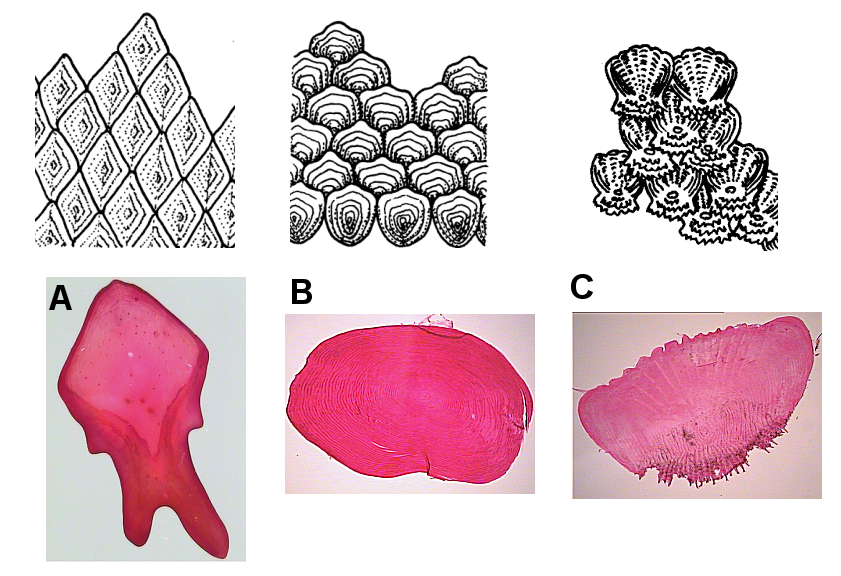
Many people try to answer the question with biology. Scientists describe five types of fish scales: placoid, cosmoid, ganoid, ctenoid, and cycloid. Sharks have placoid scales, and the OU says you rip the skin when you remove a placoid scale, so those scales can’t count as kaskeses. Lungfish have cosmoid scales. Sturgeon, gars, and bowfin have ganoid scales. According to the OU, you’ll rarely find any of those three types on a kosher fish.
Bowfin is the hard case. The OU’s writer names bowfin (Amia calva) as one kosher fish with ganoid scales. But in an article the OU reprinted from the North American Native Fishes Association, a biologist describes how Rabbi Chaim Goldberg of the OU examined a frozen bowfin in December 2003. Rabbi Goldberg wrote that he could pull the scales out cleanly, but he saw something underneath that might tear. He and another kosher fish expert concluded that the damage wasn’t severe enough to disqualify bowfin. They added that they couldn’t confirm the ruling officially without testing a fish nobody had frozen. Our bowfin page still lists bowfin as not kosher, so ask your rabbi before you eat bowfin.
Ctenoid and cycloid scales are the ones you’ll find on most kosher fish. Some rabbis have argued that any fish with those two types is kosher, and the OU’s writer disagrees for two reasons.
First, some cycloid scales are too small to see. The writer, Rabbi Juravel, and Rabbi Herbsman checked samples of a sand lance (Ammodytes americanus), a species biologists describe as having cycloid scales. None of the three could see anything large enough to count as kaskeses. Second, some fish have scales deep inside the skin. The OU names the American eel and the burbot as fish with scales that would otherwise qualify.
The OU’s writer concludes that kashrut has its own definition of kaskeses, and that scientific scale classifications don’t decide the halacha.
| Fish | Scale type | Kosher? | Reason |
|---|---|---|---|
| Shark | Placoid | ❌ No | You tear the skin to remove these scales, so they aren’t kaskeses (OU) |
| Sturgeon | Ganoid | ❌ No | An OU-hosted article lists sturgeon among the non-kosher ganoid fish. See is sturgeon kosher for the Conservative view |
| Bowfin | Ganoid | ⚠️ Unsettled | The OU’s writer calls bowfin kosher, but OU rabbis didn’t confirm a ruling officially in 2003 |
| American eel | Embedded | ❌ No | Scales too deep in the skin to remove without tearing (OU) |
| Burbot | Embedded | ❌ No | Scales too deep in the skin, and the OU calls burbot a non-kosher member of the cod family (Gadidae) |
| Sand lance | Cycloid | ⚠️ Check | The OU’s writer couldn’t see a scale large enough to count |
We built this table from the OU’s published analysis, so treat the table as a summary, not a ruling. Confirm any species with a reliable certification or your own rabbi.
How to check kosher fish scales yourself
The OU calls manual checking the easiest method. Find a scale on the side of the fish, preferably behind the gills, near the tail, or by a fin. The OU recommends those spots as a chumra, so you know you aren’t holding a scale from another fish. Grab the scale between your thumb and forefinger and slowly pull the scale out. Then look closely at the bare skin. If you see fairly undamaged skin, the fish is kosher. If you had to tear the skin to get the scale out, that scale isn’t kaskeses.
The OU notes that you’ll always find a scale’s anchored edge on the side closer to the head. A fish swimming against the current would lose any scale anchored toward the tail. For a sense of normal skin after you remove a kaskeses, the OU suggests you inspect the scaleless skin of a fish you already know is kosher.
Scaleless fish and the mesorah method
You don’t need a tradition to eat a fish that had kaskeses at some point in its life, according to the OU. On many scale-shedding species, you can still find one scale behind the gills, near the tail, or by a fin. When you can’t find any scale, the OU explains, the Darchei Teshuva allows a mesorah method. A halachically reliable person who knows that species can identify the fish by its skin, as long as nobody has removed the skin.
The OU applies this method to mackerel, since mackerel often lose their scales out of the water. We cover the species in our mackerel guide. The OU’s writer adds three limits. You generally can’t use the mesorah method once someone removes the skin. A typical fish store worker lacks the qualifications to confirm the species. And a mashgiach who doesn’t know the species can’t accept a fish by a small scaleless patch of skin.
Some hashgacha organizations accept skinless salmon, because no known fish has flesh of that red-pink color, the OU explains. Even then, the mashgiach accepting the delivery has to know salmon on sight.
When you can’t see the scales: fillets and processed fish
Once someone removes the skin, you can’t run the removal test, and the OU says you generally can’t use the mesorah method either. For skinless fillets, canned fish, and smoked fish, you’ll need a trustworthy hechsher instead. We explain the details in our guide on whether fish needs a hechsher, and in our guide to buying kosher fish.
The OU’s writer also warns against relying on a kosher fish list, because people use one common name for several different fish. Not every cod is kosher, since the non-kosher burbot is a member of the cod family. Torsk, escolar, and turbot are each names for both kosher and non-kosher fish, according to the OU.
Check Any Fish with KosherFish
When you’re standing at the counter, you can look up any fish and get a verdict for 290+ species. You can scan the full kosher fish list, or read our species pages for shark, sturgeon, eel, and bowfin.
You can run the same check from your phone with the iOS app or the Android app. KosherFish is an information tool, not a posek, so check a reliable certification or ask your own rabbi about any fish in doubt.
Kosher fish scales: frequently asked questions
What are kosher fish scales?
Kosher fish scales are scales you can remove by hand or with a knife without tearing the skin underneath. The OU cites the Ramban for this rule and uses the Torah’s Hebrew word, kaskeses. If you rip the skin when you pull out a scale, as you would with a shark’s placoid scales, that scale doesn’t count. One visible scale at any point in the fish’s life is enough.
Does a kosher fish need both fins and scales?
Yes, the verse names both, but in practice you only check the scale. Leviticus 11:9 lists fins and scales, and the OU explains that the Mishnah in Niddah 59a teaches that any fish with kaskeses also has fins. So once you confirm a kosher scale, you already know the fish has fins.
How do you check if a fish has kosher scales?
Pull a scale between your thumb and forefinger, preferably from behind the gills, near the tail, or by a fin. Then look closely at the bare skin. The OU says that if you see fairly undamaged skin, the fish is kosher. If you had to tear the skin to get the scale out, that scale isn’t kaskeses, so keep checking or ask your rabbi.
Are ctenoid and cycloid scales always kosher?
No. The OU’s writer says you’ll find ctenoid and cycloid scales on most kosher fish, but you can’t rely on the scale type alone. Some cycloid scales are too small to see, and the American eel and the burbot have scales too deep in the skin to remove cleanly. The removal test is the deciding factor.
Is a fish kosher if it lost its scales?
It can be. The OU says a fish that had kaskeses at some point in its life stays kosher, even with no scales left. When you can’t find a scale, a halachically reliable person who knows the species can identify the fish by its skin, using the mesorah method. You generally can’t use that method once someone has removed the skin.
Why aren’t sharks and sturgeon kosher if they have scales?
Their scales are the wrong kind. The OU says you tear a shark’s skin when you remove its placoid scales, so those scales aren’t kaskeses. Sturgeon have ganoid scales, a type the OU says you’ll rarely find on a kosher fish, and an OU-hosted article lists sturgeon among the non-kosher ganoid fish. You have to be able to remove a kosher scale without ripping the skin.
The Bottom Line
Kosher fish scales are scales you can remove without tearing the skin, and the OU’s writer holds that you can’t decide the halacha from scientific scale types. Check one scale behind the gills, near the tail, or by a fin, and buy skinless fillets only with a trustworthy hechsher. Browse the kosher fish list, look up any fish, and keep the iOS app or Android app handy. For more, read kosher fish basics, whether shark is kosher, and whether eel is kosher.