
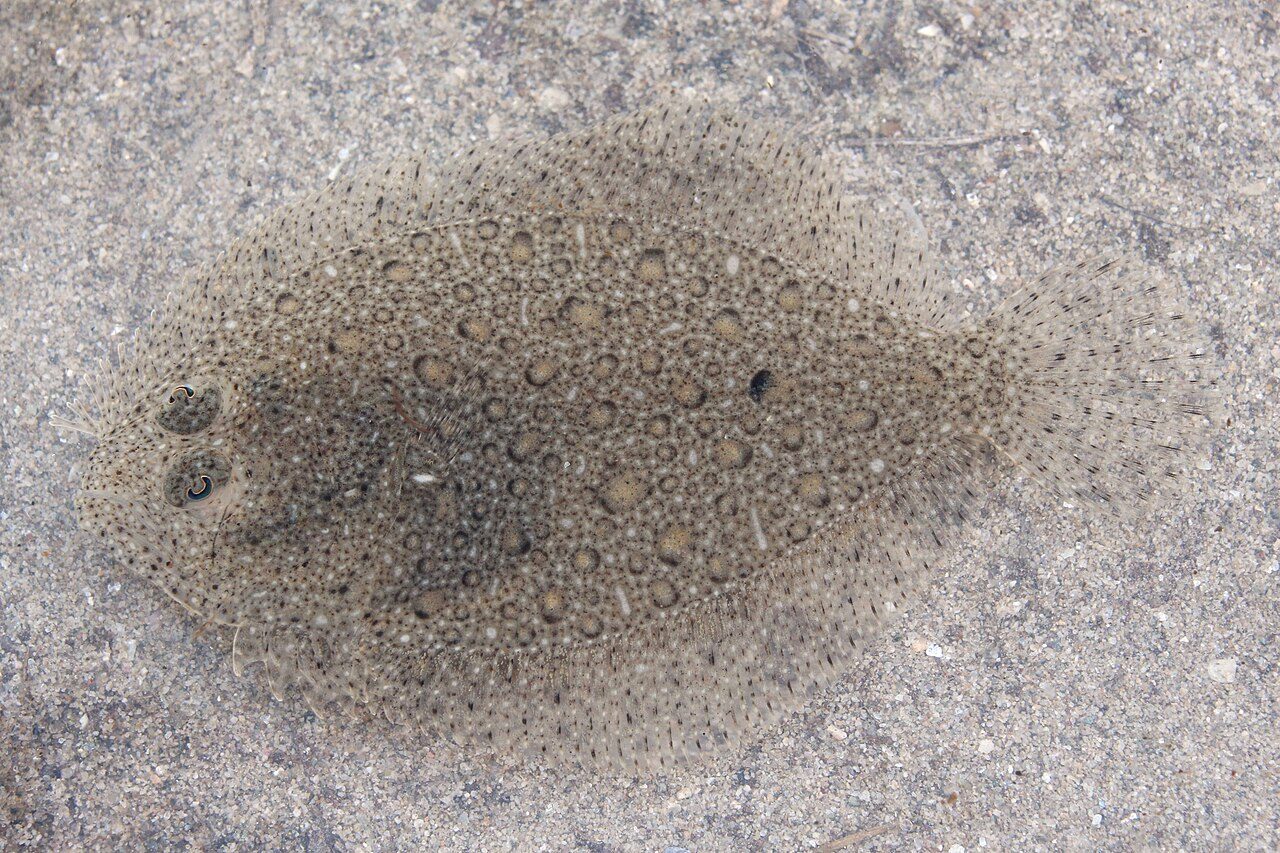
Is brill kosher? Yes. Brill (Scophthalmus rhombus) is a flatfish in the flounder family. It has fins and the kind of scales Jewish dietary law requires. Two kosher-fish references, Chabad.org’s Kosher Fish List and a list published by the Jersey Shore Orthodox Rabbinate, name it directly as kosher, and KosherFish’s own species database agrees. The catch is its closest relative: European turbot looks almost identical, shares part of its name, and isn’t kosher. You can look up brill or any of 290+ other species before you buy, or browse the full kosher fish list.
Why Brill Passes the Fins-and-Scales Test
Jewish dietary law sets one test for fish. It needs both fins and scales, and the scales have to lift off without tearing the skin. Leviticus 11:9-12 lays out the rule, repeated in Deuteronomy 14:9-10. The Hebrew term for the removable kind is kaskeset. Brill sits in the order Pleuronectiformes, alongside sole, halibut, and the wider flounder family. All of them carry visible fins and true removable scales. That physical feature is exactly what Chabad.org and the Jersey Shore Orthodox Rabbinate (JSOR) point to when they place brill under the kosher flounder heading on their fish lists.
Who Says Brill Is Kosher
More than one source answers “is brill kosher” the same way. Chabad.org’s Kosher Fish List and the JSOR’s published fish list both group brill with the kosher flounder family. KosherFish’s own database, the one behind the lookup tool on this site, lists brill as kosher too. None of the five largest national kosher agencies, the Orthodox Union (OU), the Chicago Rabbinical Council (cRc), Star-K, OK Kosher, or Kof-K, currently publishes a page naming brill by species.
That gap isn’t unusual for a fish that’s mostly a European market item rather than a US supermarket staple. It isn’t a reason to doubt the verdict either, since every source that does address brill agrees on it. The cRc’s own public guidance skips a species-by-species list on purpose. It tells shoppers to check a whole fish’s scales directly instead of trusting a name. Want a formal agency’s sign-off on a processed or packaged brill product? Ask your rabbi, or buy one that already carries a hechsher.
The Turbot Trap: Brill’s Non-Kosher Look-Alike
Here’s where the question gets interesting. Brill’s closest relative, European turbot (Scophthalmus maximus), is not kosher, and the two fish get confused constantly. They’re similar size, similar shape, similar diamond body, and they turn up at the same counters in the same European markets. KosherFish’s own database even lists “Brill” as an alias people search under the turbot entry, and “European Turbot” as an alias under the brill entry. The two names get swapped that often in everyday use. Chabad.org’s kosher fish list makes the split explicit: brill is kosher under the flounder heading, and “European turbot” is specifically excluded from that same grouping.
The Orthodox Union’s own “Mesorah Fish” article addresses this directly, without naming brill: “Turbot (some are kosher, some not)… the primary example of non-kosher (scaleless) Turbot is usually called ‘European Turbot.'” Other fish share the word “turbot,” Pacific turbot, curlfin turbot, diamond turbot, and Greenland turbot among them, and those are different species entirely, treated as kosher. So “turbot” alone doesn’t answer the question the way “brill” does. A menu, fishmonger, or recipe that says turbot deserves a follow-up question before you assume it’s the same green light as brill.
| Fish | Kosher? | Why |
|---|---|---|
| Brill (Scophthalmus rhombus) | ✅ Yes | Flounder-family flatfish with fins and removable scales, named kosher by Chabad.org and the Jersey Shore Orthodox Rabbinate |
| European turbot (Scophthalmus maximus) | ❌ No | Brill’s closest relative and often confused with it, but excluded from the same kosher flounder listing |
| Pacific, curlfin, diamond & Greenland turbot | ✅ Yes | Different species that share the word “turbot,” confirmed kosher by the OU’s Mesorah Fish guidance |
| Sole | ✅ Yes | Same flounder family, same fins-and-scales test |
| Halibut | ✅ Yes | Same order (Pleuronectiformes), fins and removable scales confirmed |
Does Brill Need a Hechsher?
Is brill kosher enough on its own to skip certification? Usually, yes, if the fish is whole, fresh, and something you can inspect yourself. You’re checking the fish directly for fins and true scales, not trusting a label. Once brill is filleted, skinned, or served at a restaurant, those identifying features are gone. Now you’re trusting whoever handled it instead. Brill and turbot sit side by side at the same counter under overlapping names often enough that a processed or restaurant-served “brill” is worth confirming, not assuming. Buy kosher-certified brill, shop at a kosher fish market, or ask your rabbi when you’re not sure what’s actually on the plate.
Buying and Cooking Kosher Brill
Ask to see brill whole or skin-on if you can. Real, removable scales confirm both fins and scales, the two-part standard behind every verdict on this site, and they’re also your quickest way to rule out a mislabeled fillet. Brill is a mild, delicate whitefish. Cooks in Europe often reach for it in place of sole or turbot, and it holds up well to pan-frying, poaching, or a simple butter sauce. It works as a Shabbat dinner main the same way cod or halibut does. Its pareve status, neither meat nor dairy, is standard for kosher fish. Many households still follow the custom of not serving fish and meat on the same plate.
Check Any Fish with KosherFish
Is brill kosher enough to stop checking once you know the answer? Not quite. The look-alike is the real risk, and that’s exactly the kind of mix-up a quick check settles. Look up brill and 290 other species on the KosherFish list, or check the brill species page for the full biological detail behind this verdict. Standing at a fish counter or reading a menu and want a fast answer? The homepage lookup tool gets you there in seconds. The iOS app or Android app puts the same lookup in your pocket.
Frequently Asked Questions
Is brill kosher?
Brill is kosher. It has fins and the removable scales Jewish dietary law requires under Leviticus 11:9-12. Chabad.org’s Kosher Fish List and the Jersey Shore Orthodox Rabbinate both list it by name under the kosher flounder family, and KosherFish’s own database agrees. The species itself isn’t in question. Its close relative, European turbot, is not kosher, so confirm which fish you actually have.
Is turbot kosher?
It depends which turbot. European turbot (Scophthalmus maximus), brill’s closest relative, is not kosher and is explicitly excluded from Chabad.org’s kosher flounder listing. Pacific turbot, curlfin turbot, diamond turbot, and Greenland turbot are different species sold under the same word, and the OU’s Mesorah Fish guidance treats those as kosher. Ask which turbot you’re buying before you assume either answer.
What’s the difference between brill and turbot?
Brill (Scophthalmus rhombus) and European turbot (Scophthalmus maximus) are closely related flatfish. They look nearly identical: similar size, similar diamond shape, sold at the same European fish counters. Turbot tends to run thicker and pricier, and its skin carries small bony tubercles brill’s skin lacks. The kosher difference is the one that matters at the counter, though: brill is kosher, European turbot is not.
Does brill need a kosher certification?
Whole fresh brill you can inspect yourself, with the skin and scales visible, generally doesn’t need kosher certification. Once it’s filleted, breaded, or served at a restaurant, you’re trusting the label instead of the fish. Given how easily brill gets confused with turbot, that’s a case where certification is worth requiring rather than assuming.
Is brill the same fish as sole or flounder?
No, brill is its own species. It belongs to the same order as sole and the wider flounder family, though, and all of them pass the identical fins-and-scales test. That shared biology is why kosher fish lists group brill under the flounder heading instead of giving it its own separate ruling.
Can I substitute turbot for brill in a recipe?
Not if the turbot is the European kind. That swap trades a kosher fish for a non-kosher one even though the recipe barely changes. Pacific, curlfin, diamond, or Greenland turbot work as a kosher substitute for brill in most recipes, since all three share the mild, delicate texture brill is known for. Confirm the species before you buy, not after you’ve cooked it.
Is brill pareve?
Brill is pareve, meaning it counts as neither meat nor dairy under Jewish dietary law, so it can be served alongside dairy dishes. Many households still keep the custom of not eating fish and meat at the same meal on the same plate. Check your own family or community practice.
The Bottom Line
Is brill kosher? Yes, with the fins and removable scales Jewish dietary law requires. Chabad.org, the Jersey Shore Orthodox Rabbinate, and KosherFish’s own database all agree. The real risk isn’t the species. It’s the fish brill gets confused with: European turbot, brill’s closest relative, is not kosher, and the two share a look, a market, and even part of a name. Buy whole and check the scales yourself, confirm which “turbot” you’re being offered, or look for kosher certification on anything filleted or served to you.
Search the full kosher fish list for the next fish you’re unsure about, browse the brill species page, or use the lookup tool on the KosherFish homepage. The iOS and Android apps handle the same check at the fish counter. Read what makes a fish kosher for more on the rule brill just passed, compare it with Is Halibut Kosher?, or learn more about when fish needs a hechsher.