
One note on the science: no fisheries source spells out whether yellow croaker’s scales are the ctenoid or cycloid type, the two textbook categories for a normal scaled fish. That’s worth flagging rather than guessing at. It also doesn’t change the verdict. Jewish law doesn’t sort fish by scale category, it asks whether the scale comes off in one piece without tearing skin, and that’s the test yellow croaker passes.
The King James translation of Leviticus 11:10 spells out the flip side in blunt terms: “And all that have not fins and scales in the seas, and in the rivers, of all that move in the waters, and of any living thing which is in the waters, they shall be an abomination unto you.” Yellow croaker never runs into that clause. It has both signs the Talmud and the later poskim look for, which is why the family it belongs to clears kosher status without controversy.
What the Kosher Authorities Say About the Croaker Family
Chabad.org’s kosher fish list names the entire drum and croaker family, Sciaenidae, as kosher, listing more than a dozen genera by name (Cynoscion, Genyonemus, Umbrina, Pogonias, Sciaenops, and others). That family-level classification is how most croakers, including yellow croaker, get their kosher status confirmed. Neither Chabad’s list nor the widely used Jewish Federation kosher fish list names Larimichthys or “yellow croaker” as its own line item, and no species-specific ruling from the OU, the cRc, OK Kosher, or Kof-K turned up naming it by name either. That’s not unusual. Most fish clear kosher status by family and by passing the fins-and-scales test directly, not because every one of the roughly 34,000 known fish species has its own line on a list somewhere.
So here’s the honest answer to is yellow croaker kosher: yes, because it’s a Sciaenidae with real fins and real removable scales, the same standard every kosher fish meets, not because a specific agency wrote its name down. If you want a species named explicitly, ask your certifying agency. They’ll confirm the same fins-and-scales read.
The Anisakis Catch: Star-K’s Yellow Corvina Restriction
Here’s the wrinkle. Star-K, one of the major American kosher certifying agencies, keeps a separate policy list for fish that can carry Anisakis, a parasitic worm. That list has nothing to do with fins or scales. Fish qualify or fail it based on infestation risk in their catch region and how they’re processed. And “Yellow Covina/Corker,” Star-K’s own spelling for yellow corvina and yellow croaker, sits on the “may not be used, even with hashgacha” side of that list, with exceptions only for fish under specific approved supervision (the Volover Rov’s Gefen brand, or the Amnon, Dagim, Dagyam, Finteva, Golden Catch, Sea Diamond, and Shindler brands certified by the cRc).
Read that carefully before you buy. Star-K says flat out that its Anisakis list “ONLY addresses” worm-infestation policy, not the fish’s underlying kosher status. Yellow croaker still has fins and scales. It’s still a kosher species. But under Star-K’s specific worm policy, an unbranded or unsupervised catch of yellow corvina or yellow croaker isn’t something Star-K considers usable, exceptions aside. If you follow Star-K’s supervision, or you’re buying for a Star-K-certified kitchen, this rule governs your purchase more than the fins-and-scales question ever will. Ask your own rabbi or certifying agency which policy applies to you.
Yellow Croaker vs. Yellowfin Croaker (Don’t Mix Them Up)
The name “croaker” covers a lot of ground, and that’s where shoppers get tripped up. Yellow croaker (Larimichthys polyactis and Larimichthys crocea) is the Asian-market fish behind this article, often labeled yellow corvina. Yellowfin croaker (Umbrina roncador) is a completely different species that swims off the California and Mexican Pacific coast, has yellowish fins and a small chin barbel, and gets its own entry in KosherFish’s species database. Atlantic croaker (Micropogonias undulatus), the fish most Americans mean when they just say “croaker,” is a third, separate species, and it already has its own guide on this site.
All three are Sciaenidae. All three pass the fins-and-scales test. But “croaker” on a fish counter label could mean any of them, and if you’re checking Star-K’s Anisakis list specifically, only the yellow croaker or yellow corvina name triggers the restriction above, not Atlantic or yellowfin croaker.
| Fish | Kosher? | Why |
|---|---|---|
| Yellow croaker / yellow corvina (Larimichthys polyactis, L. crocea) | ✅ Yes, ⚠️ Check sourcing | Sciaenidae, passes fins-and-scales, but Star-K’s Anisakis policy restricts unsupervised sourcing |
| Yellowfin croaker (Umbrina roncador) | ✅ Yes | Separate Pacific-coast Sciaenidae species, standard fins-and-scales pass, not on Star-K’s Anisakis-restricted list |
| Atlantic croaker (Micropogonias undulatus) | ✅ Yes | Covered on KosherFish’s own is croaker kosher guide |
| Generic “corvina” (various species) | ⚠️ Check | “Corvina” spans several Sciaenidae genera and is separately flagged on Star-K’s Anisakis list, confirm the exact species |
Does Yellow Croaker Need a Hechsher?
Usually not, if you buy it whole. Star-K’s fresh fish policy says a whole fish with the skin and scales still attached, sold packaged from a commercial fish company rather than cut up in front of you, can be used without a hechsher, because you can check the scales yourself. OK Kosher agrees: find scales that come off cleanly without tearing the skin, and the whole fish is permitted no matter where you bought it.
That changes the moment the fish is filleted, skinned, or otherwise processed. Once the scales are gone, you can’t verify the species yourself anymore, so filleted or skinless yellow croaker needs a reliable kosher certification on the package. Chabad.org’s guidance says the same thing plainly: anything processed and pre-packaged without the skin has to carry certification.
And because of the Anisakis restriction above, yellow croaker is one of the species where sourcing matters even more than usual when you’re deciding is yellow croaker kosher for your own table. If you keep a Star-K standard, check for one of the approved brands or hashgacha before you buy, whole or filleted.
Buying and Serving Yellow Croaker
Whole steamed yellow croaker, often sold as yellow corvina, is a staple on Chinese and other Asian dinner tables, especially for celebratory meals where a whole fish stands in for abundance. That makes it a natural fit for anyone building a kosher Asian-fusion Shabbat table, once the sourcing questions above are settled. Like other kosher fish, yellow croaker is pareve, neither meat nor dairy, so it works alongside a dairy meal. Plenty of families still keep the custom of not plating fish and meat together, so check your own household’s practice if you’re serving it as part of a bigger spread.
If you’re used to cooking other common kosher white fish, yellow croaker will feel familiar. Its flesh is mild, flaky, and pale, closer to sole or whiting than to something oily like mackerel. It sits in the same general kitchen category as halibut, turbot, black bass/" class="kf-autolink" title="Is Sea bass kosher? — KosherFish.co">sea bass, and perch, common white-fleshed fish that show up at the same kosher fish counter, and it takes well to the same simple treatments: steamed whole, pan-fried, or baked with just ginger, scallion, and a little oil. A sharp knife makes skinning or scaling easier if your fish needs any extra cleanup, and rinsing it under cold water before cooking helps remove any loose scales the fishmonger missed.
Check Any Fish with KosherFish
You don’t have to memorize any of this. Look up yellow croaker, yellow corvina, or any of 290+ other species on the kosher fish list to see the fins-and-scales verdict at a glance, and check before you’re standing at the fish counter wondering what you’re holding. The iOS app and Android app do the same lookup from your phone, so you can confirm a fish is kosher before it’s in your cart.
Frequently Asked Questions
Is yellow croaker kosher?
Yes, yellow croaker is kosher. It has fins and scales that lift off cleanly without tearing the skin, the standard Leviticus 11:9-12 sets for kosher fish, and it belongs to Sciaenidae, the drum and croaker family the kosher authorities already recognize. The catch isn’t about its kosher status. Star-K’s separate Anisakis worm policy restricts unsupervised yellow corvina, so check the sourcing before you buy.
What is yellow croaker also called?
Yellow croaker usually means Larimichthys polyactis, the small or little yellow croaker, also sold as yellow corvina or redlip croaker, or its larger relative Larimichthys crocea. Star-K’s kosher fish paperwork spells the market name “Yellow Covina/Corker.” Don’t confuse it with yellowfin croaker (Umbrina roncador), a different Pacific Coast species, or plain Atlantic croaker, a third, separate fish.
Does yellow croaker need a hechsher?
A whole yellow croaker with its skin and scales still attached generally doesn’t need a hechsher, since you can check the scales yourself, per Star-K and OK Kosher’s fresh fish guidance. Filleted or skinless yellow croaker does need certification, because the scales that prove its species are gone. Given Star-K’s Anisakis restriction on the fish, confirm an approved brand or hashgacha either way.
Is yellow croaker the same fish as yellowfin croaker?
No. Yellow croaker (Larimichthys polyactis and Larimichthys crocea) is an Asian-market fish often sold as yellow corvina. Yellowfin croaker (Umbrina roncador) is a separate species that lives off the California and Mexican Pacific coast. Both belong to the Sciaenidae family and both pass the fins-and-scales test, but a fish counter labeled simply “croaker” could mean either one, or a third species, Atlantic croaker.
Why does Star-K restrict yellow corvina?
Star-K’s Anisakis Fish Policy lists “Yellow Covina/Corker” among fish that may not be used, even with hashgacha, because of the risk of Anisakis worm infestation, not because of its kosher fin-and-scale status. Star-K says the list only addresses worm risk. Exceptions exist for fish under specific approved supervision, like the Volover Rov’s Gefen brand or several brands certified by the cRc.
Is croaker kosher for Passover?
Yes, kosher whole fish like yellow croaker is fine for Passover, since fish isn’t chametz and doesn’t carry the grain restrictions matzah and other Passover foods do. The same rules apply as any other time of year: buy it whole with scales intact to skip the hechsher question, or choose a certified processed product if it’s filleted, and check your own community’s Passover fish customs.
Is yellow croaker pareve?
Yes, yellow croaker is pareve, like all kosher fish, meaning it’s neither meat nor dairy and can be served alongside either. Many families still follow a longstanding custom of not eating fish and meat on the same plate or in the same course, even though fish is pareve. Check your own household’s practice, especially if you’re building a mixed meat-and-fish menu.
The Bottom Line
Is yellow croaker kosher? Yes. It has fins and removable scales, the Torah’s standard from Leviticus 11:9-12, and it belongs to Sciaenidae, a family the kosher authorities already recognize. The one thing to watch is sourcing: Star-K’s Anisakis worm policy restricts unsupervised yellow corvina and yellow croaker, so check for an approved brand or hashgacha before you buy, especially if you follow Star-K supervision. Browse the full kosher fish list, look up the related drums and croakers family entry, or check any fish in seconds with the iOS or Android app. For more on the fins-and-scales rule itself, read what makes a fish kosher, and if you’re curious about the Atlantic species specifically, see is croaker kosher.
Yellow croaker is kosher. It has fins and the kind of scales that lift off cleanly, the two signs the Torah requires in Leviticus 11:9-12, and it sits in Sciaenidae, the drum and croaker family that’s already established as kosher. That’s the short answer to is yellow croaker kosher. But there’s a wrinkle worth knowing before you buy one, and it has nothing to do with fins or scales. Check yellow croaker, or any of 290+ other species, on the KosherFish lookup tool before you cook it.
Why Yellow Croaker Passes the Fins-and-Scales Test
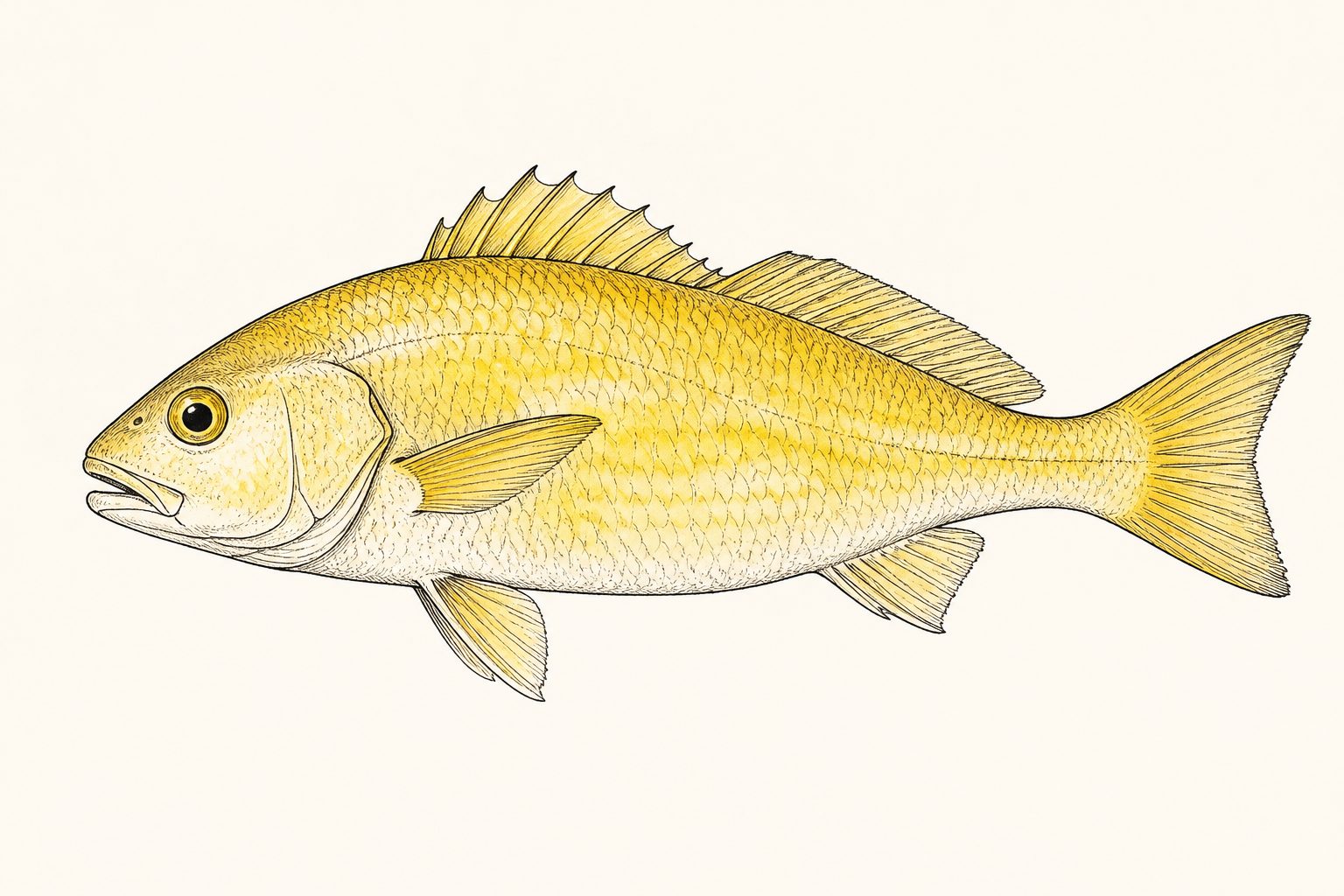
“Yellow croaker” usually means one of two related fish: Larimichthys polyactis, the small or little yellow croaker, also sold as yellow corvina or redlip croaker, and Larimichthys crocea, the large yellow croaker. Both live in the family Sciaenidae, the drums and croakers, a group of bony, scaled fish common across Chinese and other Asian markets. Both have the standard body plan of a true fish. A dorsal fin, a caudal fin, paired pectoral and pelvic fins, and a body covered in overlapping scales that come off with a scaler or the dull edge of a knife.
That matters because the Torah sets a two-part test for kosher fish. Leviticus 11:9-12 and Deuteronomy 14:9-10 require fins and scales, and Jewish law is specific about which scales count. The Orthodox Union’s own explainer on kaskeses, the halachic term for scales, puts it plainly: a valid scale has to come off by hand or with a knife without tearing the skin underneath. Sturgeon and shark fail that test because their scales are embedded, not layered on top. Yellow croaker doesn’t have that problem. Its scales sit loosely enough to slide off with a light scrape, the same way they do on salmon or snapper.
There’s a shortcut worth knowing too. The Mishnah establishes that any fish with true, removable scales automatically has fins, so checking the scales alone is enough to confirm a fish clears the bar. Yellow croaker clears it.
One note on the science: no fisheries source spells out whether yellow croaker’s scales are the ctenoid or cycloid type, the two textbook categories for a normal scaled fish. That’s worth flagging rather than guessing at. It also doesn’t change the verdict. Jewish law doesn’t sort fish by scale category, it asks whether the scale comes off in one piece without tearing skin, and that’s the test yellow croaker passes.
The King James translation of Leviticus 11:10 spells out the flip side in blunt terms: “And all that have not fins and scales in the seas, and in the rivers, of all that move in the waters, and of any living thing which is in the waters, they shall be an abomination unto you.” Yellow croaker never runs into that clause. It has both signs the Talmud and the later poskim look for, which is why the family it belongs to clears kosher status without controversy.
What the Kosher Authorities Say About the Croaker Family
Chabad.org’s kosher fish list names the entire drum and croaker family, Sciaenidae, as kosher, listing more than a dozen genera by name (Cynoscion, Genyonemus, Umbrina, Pogonias, Sciaenops, and others). That family-level classification is how most croakers, including yellow croaker, get their kosher status confirmed. Neither Chabad’s list nor the widely used Jewish Federation kosher fish list names Larimichthys or “yellow croaker” as its own line item, and no species-specific ruling from the OU, the cRc, OK Kosher, or Kof-K turned up naming it by name either. That’s not unusual. Most fish clear kosher status by family and by passing the fins-and-scales test directly, not because every one of the roughly 34,000 known fish species has its own line on a list somewhere.
So here’s the honest answer to is yellow croaker kosher: yes, because it’s a Sciaenidae with real fins and real removable scales, the same standard every kosher fish meets, not because a specific agency wrote its name down. If you want a species named explicitly, ask your certifying agency. They’ll confirm the same fins-and-scales read.
The Anisakis Catch: Star-K’s Yellow Corvina Restriction
Here’s the wrinkle. Star-K, one of the major American kosher certifying agencies, keeps a separate policy list for fish that can carry Anisakis, a parasitic worm. That list has nothing to do with fins or scales. Fish qualify or fail it based on infestation risk in their catch region and how they’re processed. And “Yellow Covina/Corker,” Star-K’s own spelling for yellow corvina and yellow croaker, sits on the “may not be used, even with hashgacha” side of that list, with exceptions only for fish under specific approved supervision (the Volover Rov’s Gefen brand, or the Amnon, Dagim, Dagyam, Finteva, Golden Catch, Sea Diamond, and Shindler brands certified by the cRc).
Read that carefully before you buy. Star-K says flat out that its Anisakis list “ONLY addresses” worm-infestation policy, not the fish’s underlying kosher status. Yellow croaker still has fins and scales. It’s still a kosher species. But under Star-K’s specific worm policy, an unbranded or unsupervised catch of yellow corvina or yellow croaker isn’t something Star-K considers usable, exceptions aside. If you follow Star-K’s supervision, or you’re buying for a Star-K-certified kitchen, this rule governs your purchase more than the fins-and-scales question ever will. Ask your own rabbi or certifying agency which policy applies to you.
Yellow Croaker vs. Yellowfin Croaker (Don’t Mix Them Up)
The name “croaker” covers a lot of ground, and that’s where shoppers get tripped up. Yellow croaker (Larimichthys polyactis and Larimichthys crocea) is the Asian-market fish behind this article, often labeled yellow corvina. Yellowfin croaker (Umbrina roncador) is a completely different species that swims off the California and Mexican Pacific coast, has yellowish fins and a small chin barbel, and gets its own entry in KosherFish’s species database. Atlantic croaker (Micropogonias undulatus), the fish most Americans mean when they just say “croaker,” is a third, separate species, and it already has its own guide on this site.
All three are Sciaenidae. All three pass the fins-and-scales test. But “croaker” on a fish counter label could mean any of them, and if you’re checking Star-K’s Anisakis list specifically, only the yellow croaker or yellow corvina name triggers the restriction above, not Atlantic or yellowfin croaker.
| Fish | Kosher? | Why |
|---|---|---|
| Yellow croaker / yellow corvina (Larimichthys polyactis, L. crocea) | ✅ Yes, ⚠️ Check sourcing | Sciaenidae, passes fins-and-scales, but Star-K’s Anisakis policy restricts unsupervised sourcing |
| Yellowfin croaker (Umbrina roncador) | ✅ Yes | Separate Pacific-coast Sciaenidae species, standard fins-and-scales pass, not on Star-K’s Anisakis-restricted list |
| Atlantic croaker (Micropogonias undulatus) | ✅ Yes | Covered on KosherFish’s own is croaker kosher guide |
| Generic “corvina” (various species) | ⚠️ Check | “Corvina” spans several Sciaenidae genera and is separately flagged on Star-K’s Anisakis list, confirm the exact species |
Does Yellow Croaker Need a Hechsher?
Usually not, if you buy it whole. Star-K’s fresh fish policy says a whole fish with the skin and scales still attached, sold packaged from a commercial fish company rather than cut up in front of you, can be used without a hechsher, because you can check the scales yourself. OK Kosher agrees: find scales that come off cleanly without tearing the skin, and the whole fish is permitted no matter where you bought it.
That changes the moment the fish is filleted, skinned, or otherwise processed. Once the scales are gone, you can’t verify the species yourself anymore, so filleted or skinless yellow croaker needs a reliable kosher certification on the package. Chabad.org’s guidance says the same thing plainly: anything processed and pre-packaged without the skin has to carry certification.
And because of the Anisakis restriction above, yellow croaker is one of the species where sourcing matters even more than usual when you’re deciding is yellow croaker kosher for your own table. If you keep a Star-K standard, check for one of the approved brands or hashgacha before you buy, whole or filleted.
Buying and Serving Yellow Croaker
Whole steamed yellow croaker, often sold as yellow corvina, is a staple on Chinese and other Asian dinner tables, especially for celebratory meals where a whole fish stands in for abundance. That makes it a natural fit for anyone building a kosher Asian-fusion Shabbat table, once the sourcing questions above are settled. Like other kosher fish, yellow croaker is pareve, neither meat nor dairy, so it works alongside a dairy meal. Plenty of families still keep the custom of not plating fish and meat together, so check your own household’s practice if you’re serving it as part of a bigger spread.
If you’re used to cooking other common kosher white fish, yellow croaker will feel familiar. Its flesh is mild, flaky, and pale, closer to sole or whiting than to something oily like mackerel. It sits in the same general kitchen category as halibut, turbot, black sea bass, and perch, common white-fleshed fish that show up at the same kosher fish counter, and it takes well to the same simple treatments: steamed whole, pan-fried, or baked with just ginger, scallion, and a little oil. A sharp knife makes skinning or scaling easier if your fish needs any extra cleanup, and rinsing it under cold water before cooking helps remove any loose scales the fishmonger missed.
Check Any Fish with KosherFish
You don’t have to memorize any of this. Look up yellow croaker, yellow corvina, or any of 290+ other species on the kosher fish list to see the fins-and-scales verdict at a glance, and check before you’re standing at the fish counter wondering what you’re holding. The iOS app and Android app do the same lookup from your phone, so you can confirm a fish is kosher before it’s in your cart.
Frequently Asked Questions
Is yellow croaker kosher?
Yes, yellow croaker is kosher. It has fins and scales that lift off cleanly without tearing the skin, the standard Leviticus 11:9-12 sets for kosher fish, and it belongs to Sciaenidae, the drum and croaker family the kosher authorities already recognize. The catch isn’t about its kosher status. Star-K’s separate Anisakis worm policy restricts unsupervised yellow corvina, so check the sourcing before you buy.
What is yellow croaker also called?
Yellow croaker usually means Larimichthys polyactis, the small or little yellow croaker, also sold as yellow corvina or redlip croaker, or its larger relative Larimichthys crocea. Star-K’s kosher fish paperwork spells the market name “Yellow Covina/Corker.” Don’t confuse it with yellowfin croaker (Umbrina roncador), a different Pacific Coast species, or plain Atlantic croaker, a third, separate fish.
Does yellow croaker need a hechsher?
A whole yellow croaker with its skin and scales still attached generally doesn’t need a hechsher, since you can check the scales yourself, per Star-K and OK Kosher’s fresh fish guidance. Filleted or skinless yellow croaker does need certification, because the scales that prove its species are gone. Given Star-K’s Anisakis restriction on the fish, confirm an approved brand or hashgacha either way.
Is yellow croaker the same fish as yellowfin croaker?
No. Yellow croaker (Larimichthys polyactis and Larimichthys crocea) is an Asian-market fish often sold as yellow corvina. Yellowfin croaker (Umbrina roncador) is a separate species that lives off the California and Mexican Pacific coast. Both belong to the Sciaenidae family and both pass the fins-and-scales test, but a fish counter labeled simply “croaker” could mean either one, or a third species, Atlantic croaker.
Why does Star-K restrict yellow corvina?
Star-K’s Anisakis Fish Policy lists “Yellow Covina/Corker” among fish that may not be used, even with hashgacha, because of the risk of Anisakis worm infestation, not because of its kosher fin-and-scale status. Star-K says the list only addresses worm risk. Exceptions exist for fish under specific approved supervision, like the Volover Rov’s Gefen brand or several brands certified by the cRc.
Is croaker kosher for Passover?
Yes, kosher whole fish like yellow croaker is fine for Passover, since fish isn’t chametz and doesn’t carry the grain restrictions matzah and other Passover foods do. The same rules apply as any other time of year: buy it whole with scales intact to skip the hechsher question, or choose a certified processed product if it’s filleted, and check your own community’s Passover fish customs.
Is yellow croaker pareve?
Yes, yellow croaker is pareve, like all kosher fish, meaning it’s neither meat nor dairy and can be served alongside either. Many families still follow a longstanding custom of not eating fish and meat on the same plate or in the same course, even though fish is pareve. Check your own household’s practice, especially if you’re building a mixed meat-and-fish menu.
The Bottom Line
Is yellow croaker kosher? Yes. It has fins and removable scales, the Torah’s standard from Leviticus 11:9-12, and it belongs to Sciaenidae, a family the kosher authorities already recognize. The one thing to watch is sourcing: Star-K’s Anisakis worm policy restricts unsupervised yellow corvina and yellow croaker, so check for an approved brand or hashgacha before you buy, especially if you follow Star-K supervision. Browse the full kosher fish list, look up the related drums and croakers family entry, or check any fish in seconds with the iOS or Android app. For more on the fins-and-scales rule itself, read what makes a fish kosher, and if you’re curious about the Atlantic species specifically, see is croaker kosher.