
Is pompano kosher? Yes. Pompano is a kosher fish, because the Orthodox Union (OU) kosher fish list names pompanos in its jacks and pompanos entry, and the fish has the fins and scales the Torah requires. The catch is the cut. A skinless fillet has lost the proof, so buy pompano whole, or under reliable supervision. You can check it and 290+ other fish on the full kosher fish list.
The short answer on whether pompano is kosher
One test applies to every sea creature in the Torah. Leviticus 11:9-12 and Deuteronomy 14:9-10 say a fish is kosher if it has both fins and scales. The OU kosher fish list, which Chabad.org reprints with permission, includes the entry “Jacks and Pompanos,” and it says the entry includes “Pompanos, palometas, and permits.” The same entry names amberjacks and yellowtails, scads, crevalles, and blue runners.
You can read the same verdict on our pompano page. The list comes with a warning, and it matters here. On kashrut.com, the copy of the list says in capital letters that it is not a list of OU kosher certified fish, and it tells readers to buy only from a reliable kosher fish store or to buy fish with the skin on, fish they can identify themselves. We found no separate pompano line on the Star-K or OK pages we checked, so the OU list is the authority we cite here. If you want a second opinion, ask your own rabbi.
Why pompano passes the fins and scales test
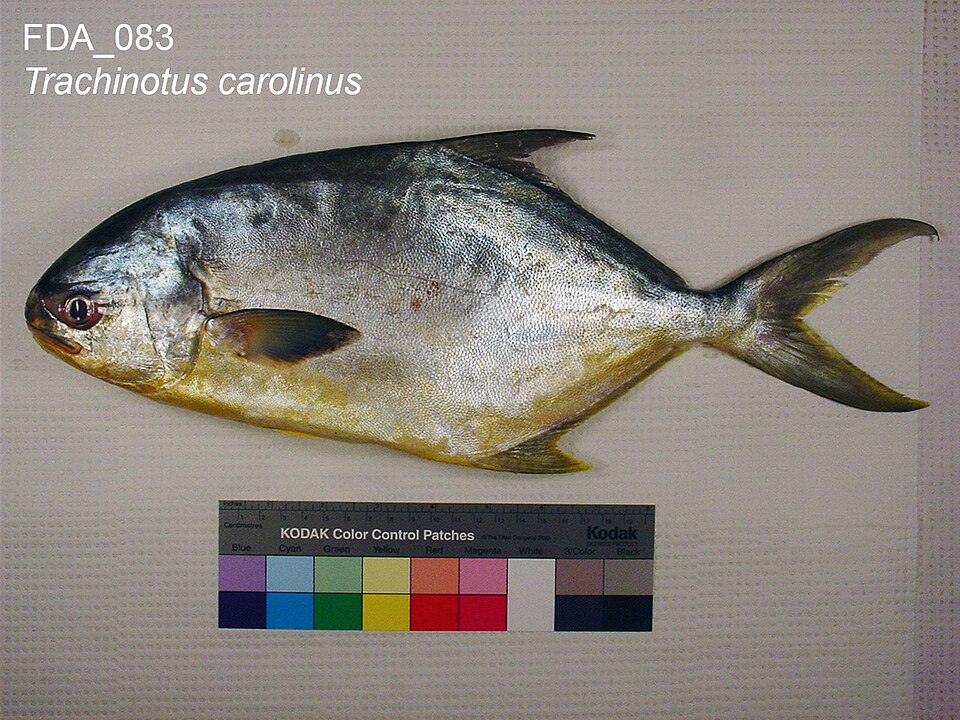
Start with the fish. You can recognize a Florida pompano (Trachinotus carolinus) by its compressed body, short snout, and deeply forked tail. The back looks blue-greenish silver, and the body and fins range from silver to yellow. It belongs to the genus Trachinotus, the same genus the OU list names. Wikipedia says this pompano fish ranges from Massachusetts to Brazil, prefers warm water between 70 and 89 degrees, and is most common along the coast near Florida. Schools patrol the surf flats. Anglers land most of them under 3 pounds and 17 inches, and the biggest on record weighed 8 to 9 pounds.
Now the rule. Rabbi Yehuda Shurpin of Chabad.org explains that the Torah’s word for scales is kaskeses, and that scales must be visible and easy to remove, either by hand or with a tool. He notes that the Talmud compares them to a garment, citing I Samuel 17:5. Scales that tear the skin when they come off disqualify a fish, and so do scales shaped like thorns. He adds that any fish with scales also has fins, a rule his footnotes trace to Mishnah Niddah 6:9 and Chullin 66b. We explain the full rule in our guide on what makes a fish kosher.
The OU entry does the heavy lifting for pompano. It names the whole group of pompanos, so the verdict covers the Florida pompano and the other fish the list files under that name.
Pompano vs the fish people confuse it with
Several fish share the name or the shape of the pompano. The table shows each one and the authority behind the answer.
| Fish | Kosher? | Source and condition |
|---|---|---|
| Pompano, whole with skin and scales | Yes | The OU list names pompanos (Trachinotus) in its jacks and pompanos entry. Confirm the scales come off without tearing the skin |
| Pompano, skinless fillet | Needs a hechsher | Without skin nobody can identify the species. Star-K says a fillet without proper signs is not acceptable |
| Permit and palometa | Yes | The same OU list entry names them with the pompanos |
| Pacific pompano (Peprilus similimus) | Yes | The OU list files it under butterfishes |
| Leatherjacket (Oligoplites saurus) | No | The OU list excludes it by name from the jacks and pompanos entry |
| Pompano dolphinfish (Coryphaena equiselis) | Yes | Not a jack. The OU list covers it in a separate entry for mahi-mahis and the rest of the genus Coryphaena. Anglers often mistake it for a juvenile mahi-mahi (Wikipedia) |
Market names and the leatherjacket trap
Names cause most kosher mistakes with fish. An editor’s note on Chabad.org’s copy of the list warns that “the common, unscientific, names of fish are very inaccurate,” and adds that the list’s use is “very limited” in practice. Pompano shows why. Wikipedia lists African, Cayenne, and Florida pompano as kinds of pompano, and it flags Pampus argenteus, a silver pomfret, as a different fish. The OU list also files a Pacific pompano under butterfishes, a separate entry from the jacks. We cover that fish in our post on whether butterfish is kosher.
The most important trap sits inside the jack family itself. The OU list ends the entry with “BUT NOT INCLUDING: LEATHERJACKET (Oligoplites saurus).” A seller who says anything in the jack family is fine has not read the list. Wikipedia adds that the Florida pompano looks very similar to the permit. Pompano dolphinfish is a different case. Its name doesn’t make it a jack, and the OU list clears it under its own Coryphaena entry. We explain that verdict in our guide on whether mahi-mahi is kosher.
Ask the seller for the Latin name, Trachinotus, and look at the skin. Skip any piece from a seller who cannot name the species or who hands you skinless fish. Find a counter with a mashgiach instead.
Does pompano need a hechsher?
You need no certification for a whole pompano with its skin and scales, because you can see the scales and check them yourself. The OU says the same about fresh, whole, skin-on fish: “No certification needed, just confirm scales can be removed without ripping skin.” Lift the loose edge of a scale and pluck it. If the skin stays intact, the scale counts.
Fillets change the answer. Rabbi Moshe Heinemann of Star-K writes that a fishery may need to leave a patch of skin with scales on each fillet so a mashgiach can check it, and that a fillet without proper signs “is not acceptable as kosher.” The OU asks for Pesach certification on skinless fresh or frozen fish at Passover. Some certifiers make an exception for salmon fillets, and Star-K doesn’t even do that, so plan on a hechsher for any skinless pompano fillet. For more detail, read our guide on whether fish needs a hechsher.
Pompano en papillote is a trap for kosher cooks
One New Orleans dish made pompano famous, pompano en papillote. Wikipedia describes the cooks wrapping the fish in parchment with a white sauce of wine, shrimp, and crabmeat, then steaming it. The fish is kosher. The classic sauce is not, because shrimp and crabmeat are shellfish. A kosher cook can keep the parchment method and swap the sauce for wine, herbs, and vegetables.
Chefs like the fish because its fillets come out an even thickness, so they cook evenly. Wikipedia calls the flavor “rich but mild” and says the flesh is oily, white, and opaque. Farms raise pompano too, and a typical farm-raised fish reaches 1 to 1.5 pounds. You can buy that size whole, which keeps the skin and scales on for your check.
Pompano for Shabbat and the holidays
Pompano suits a Friday night fish course. A whole fish with the skin on settles the identification question before you cook it, and the mild flavor takes most sauces. Fish is pareve, but many communities keep it apart from meat on the same plate, so serve it as its own course. We explain the custom in our post on fish and meat, and the menu ideas in our guide to kosher fish for a Shabbat dinner.
Florida produces over 90 percent of the annual pompano harvest, mostly from the western coast, Wikipedia reports, and a 2005 Florida Fish and Wildlife Conservation Commission study found the population healthy and the fishery sustainable under current practices. Check the current rules before you keep a catch of your own.
Check Any Fish with KosherFish
You can look up pompano and 290+ other fish on the full kosher fish list, or type any name into the KosherFish lookup tool. At the counter, the iOS and Android apps give you the same answer in a few seconds. You get what the published lists say, nothing more, so keep asking your rabbi and keep reading the hechsher on processed products.
Pompano kosher FAQ
Is pompano kosher?
Pompano is kosher. It has fins and scales, which meets the Torah test in Leviticus 11:9-12, and the OU kosher fish list names pompanos, palometas, and permits in its jacks and pompanos entry. Buy it whole with the skin on, because a skinless fillet needs reliable supervision.
Why is pompano kosher?
Pompano has both fins and scales, and the scales must come off without tearing the skin. Chabad.org’s Rabbi Shurpin says kosher scales are visible and easy to remove, and that any fish with scales also has fins. The OU list names the whole pompano group in its jacks and pompanos entry.
Is Florida pompano kosher?
Yes. The Florida pompano (Trachinotus carolinus) belongs to the pompanos that the OU kosher fish list names in its jacks and pompanos entry. Common fish names are unreliable, an editor’s note on the list warns, so buy the fish whole with the skin on, or ask your rabbi about a fillet.
Is pompano fish kosher without a hechsher?
Only whole and skin-on. A fresh whole fish with skin needs no certification if you can confirm the scales come off without ripping the skin, the OU says. A skinless fillet is different. Star-K says a fillet without proper signs is not acceptable, so look for a hechsher at the counter.
Is pompano dolphinfish kosher?
Yes, but under its own entry. Pompano dolphinfish (Coryphaena equiselis) isn’t a pompano. It belongs to the dolphinfish family with mahi-mahi, and the OU kosher fish list covers it in its entry for mahi-mahis and the rest of the genus Coryphaena. The list adds that the mammal called a dolphin is not kosher. Buy it whole with the skin on, as with any fish.
Is leatherjacket kosher like pompano?
No. The OU kosher fish list ends its jacks and pompanos entry with the words, BUT NOT INCLUDING: LEATHERJACKET (Oligoplites saurus). So a fish from the jack family is not automatically kosher. Confirm the species by name before you buy, and ask your rabbi if you are unsure.
Is pompano en papillote kosher?
The classic recipe is not kosher. The fish is kosher, but the New Orleans dish uses a sauce of wine, shrimp, and crabmeat, and shrimp and crabmeat are shellfish. You can cook pompano in parchment with wine, herbs, and vegetables instead, and keep the dish kosher.
The Bottom Line
So is pompano kosher? Yes. It has fins and scales, and the OU list names the pompanos. Buy it whole with the skin on, or under a hechsher if you want a fillet, and watch for the leatherjacket exception. Read the pompano page, browse the full kosher fish list, or start from the KosherFish lookup tool. The apps are on iOS and Android. For more, read about what makes a fish kosher and how to buy kosher fish, and ask your own rabbi if anything is unclear.