Kosher foods for Hanukkah follow the same kashrut rules as every other day of the year. The holiday adds customs, not new laws: foods fried in oil and, for many families, dairy dishes. Hanukkah 2026 starts at nightfall on December 4 and ends at nightfall on December 12, according to Chabad.org. If a fish ends up on your table that week, you can check it on the KosherFish lookup tool first.
Kosher Foods for Hanukkah Follow the Usual Rules
Hanukkah is not a food holiday with its own list of required dishes. Nobody has to eat a latke to keep the holiday. The foods are customs that grew up around the story of the oil, and each one still has to be kosher like any other meal.
Chabad.org’s Hanukkah food guide puts the baseline in one line: cook on kosher utensils and keep meat and dairy separate. Two more rules matter in December. Chabad.org says processed foods need kosher certification, and you should check leafy greens and other vegetables for infestations. The Orthodox Union (OU) makes the same point about produce in its Hanukkah recipe column by Norene Gilletz, which tells readers to inspect fresh fruit and vegetables for insects.
That is the whole rulebook. If you already keep a kosher kitchen, you don’t need new pots for Hanukkah. If you’re still setting one up, start with our guide on how to keep kosher and the basics of meat and dairy.
Why Jews Eat Foods Fried in Oil on Hanukkah
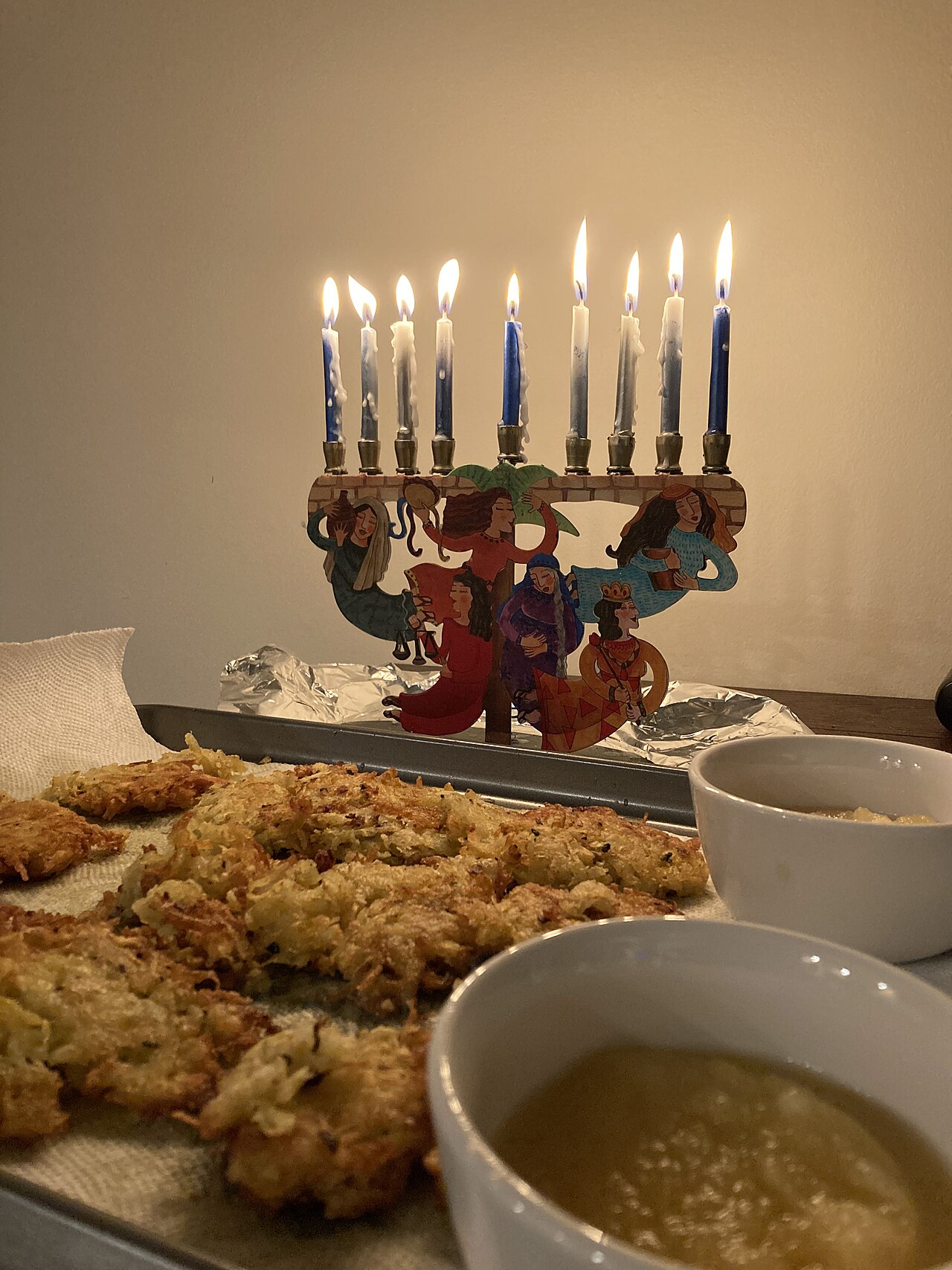
The custom is to eat foods fried in oil, in remembrance of the oil that lasted eight days. That is how Chabad.org describes the practice, and the OU column calls it traditional to eat foods fried in oil, including latkes and sufganiyot.
The custom is old. Chabad.org traces the earliest mention to Rabbi Maimon ben Joseph (born around 1110), the father of Maimonides. He wrote about making sufganin, which he called alsfingh in Arabic, and said: “This is an ancient custom, because they are fried in oil, in remembrance of His blessing.”
Chabad.org also notes that some families eat latkes, which are fried potato pancakes, while others eat sufganiyot or bumuelos, which are deep-fried doughnuts. The Hanukkah food page on Chabad.org says the sufganiyot may derive from a yeast dough pastry mentioned in the Talmud. It says the name sufganin means absorbent, because the pastries soaked up so much oil. In northern communities, it says, olive oil was scarce and expensive, so cooks fried in goose or chicken fat, and potato latkes and apple fritters became the norm. Today most cooks can afford olive oil or another pareve oil.
Pareve means neither meat nor dairy, so a pareve oil keeps your latkes flexible. We cover the term in detail in our post on what pareve means.
Why Many Families Eat Dairy on Hanukkah
The dairy custom honors Yehudit, the Jewish heroine of the Hanukkah story. Chabad.org says she fed a Greek general salty cheese, gave him wine so he’d be thirsty, and killed him once he fell asleep, after which the Greek army fled. The OU column ties the dairy custom to the same heroine, who killed the general Holofernes. In her memory, Chabad.org says, we eat dairy products as well.
This is a custom, not a requirement. Plenty of families skip it. If you serve cheese latkes or cheese blintzes, the usual dairy rules apply. Keep the dairy dishes on dairy utensils, and don’t put meat on the same table setting.
Which Hanukkah Foods Need a Hechsher?
A hechsher is a kosher certification mark from a reliable agency. Homemade food from raw ingredients is usually the easy case. Packaged and bakery food is where the label matters. Chabad.org says processed foods need kosher certification, so the same standard applies to a box of latke mix, a bag of frozen latkes, or a tray of sufganiyot from a bakery.
| Hanukkah food | Kosher status | What to check |
|---|---|---|
| Homemade latkes from fresh potatoes | Yes | Cook on kosher utensils and use a pareve oil such as olive oil (Chabad.org) |
| Packaged latke mix or frozen latkes | Check | Processed foods need kosher certification (Chabad.org) |
| Bakery sufganiyot (doughnuts) | Check | Look for the bakery’s certificate or a hechsher on the box |
| Jelly or cream fillings | Check | Packaged fillings fall under the processed-food rule |
| Cheese latkes and blintzes | Yes | Dairy on dairy utensils, and keep meat off the table setting |
| Fresh greens and vegetables | Check | Inspect for insects (OU and Chabad.org) |
Not sure what a symbol means? Our guide to kosher symbols walks through the common marks, and what the OU symbol means covers the most common one.
Hanukkah Begins on Friday Night in 2026
Hanukkah 2026 starts at nightfall on a Friday, which puts the first candle on Shabbat eve. Chabad.org says to light the menorah on Friday afternoon before lighting the Shabbat candles. It also says the Friday night Hanukkah candles must burn for at least an hour and a half, and that on Saturday night you light the menorah after dark, after Havdalah.
That timing shapes the menu. You’ll plan the first Friday night dinner as a Shabbat meal, so our post on kosher for Shabbat applies to night one.
Serving Fish During Hanukkah
Fish is not a Hanukkah custom, but many families serve it at Shabbat dinner during the holiday. Kosher fish is pareve, so it works at a dairy or a meat meal, though many communities avoid eating fish and meat together. We explain that custom in our post on eating fish and meat together, and our guide to the best kosher fish for Shabbat dinner picks the dependable choices.
A kosher fish needs fins and scales, per Leviticus 11:9-12 and Deuteronomy 14:9-10. Salmon passes. Shellfish and catfish don’t. Your own rabbi has the final word on anything you’re unsure about.
Check Any Fish with KosherFish
If a fish is on your Hanukkah menu, you can look it up before you buy. The KosherFish lookup tool covers 290+ species, and the full kosher fish list shows every one with its status. You can also check on the go with the iOS app or the Android app while you stand at the fish counter.
The tool answers fish questions only. For a packaged latke mix or a box of doughnuts, the hechsher on the package is what counts. Our guide to kosher fish for Jewish holidays covers the rest of the calendar.
Hanukkah Food Questions
What are the kosher foods for Hanukkah?
Nobody has to eat a particular dish. Chabad.org says the custom is to eat foods fried in oil, such as latkes and sufganiyot, to remember the oil that lasted eight days. Many families also eat dairy dishes in memory of Yehudit. Every dish still has to be kosher, with certification on any processed item.
Why do we eat latkes on Hanukkah?
Cooks fry latkes in oil, and Chabad.org says the custom is to eat foods fried in oil to remember the oil that lasted eight days. Potato became the usual base in northern communities. Chabad.org also notes that some families eat sufganiyot instead, so the oil matters more than the dish.
Why do people eat dairy on Hanukkah?
The dairy custom honors Yehudit, who fed a Greek general salty cheese and wine before he fell asleep, per Chabad.org. The OU ties the custom to her too. It is a custom and not a law. If you serve dairy, keep it on dairy utensils and away from meat.
Are sufganiyot kosher?
Sufganiyot can be kosher, but the status depends on the bakery or the recipe. Chabad.org says processed foods need kosher certification, so check the bakery’s certificate or the hechsher on the box. A homemade batch fried in pareve oil on kosher utensils is the easy case.
What oil should I use for Hanukkah latkes?
Most cooks use olive oil or another pareve oil, and Chabad.org notes that pareve oil is now affordable and common. Pareve oil keeps the latkes neutral, so you can serve them with dairy or alongside a meat meal. Check any packaged oil for kosher certification, as with every processed food.
Can you eat fish on Hanukkah?
Yes. Fish is pareve, and a kosher fish needs fins and scales under Leviticus 11:9-12. Many communities avoid eating fish and meat together. Look up the species on the KosherFish list, and ask your rabbi about anything you’re unsure of.
Does Hanukkah have special kosher rules?
No. Chabad.org says to cook on kosher utensils, keep meat and dairy separate, and get certification for processed foods. You should also check vegetables for insects. Hanukkah adds customs about oil and dairy but no extra kosher laws, so a kitchen that’s kosher in November is ready in December.
The Bottom Line
Kosher foods for Hanukkah are ordinary kosher food with two customs on top: oil-fried dishes and dairy. Cook on kosher utensils, keep meat and dairy apart, check the hechsher on anything processed, and inspect your vegetables. Start with the kosher fish list if fish is on the menu, and open the KosherFish lookup tool or the apps to check a species fast.
Planning the rest of the year? Read our posts on Rosh Hashanah kosher foods, Sukkot kosher foods, and kosher for Passover.