
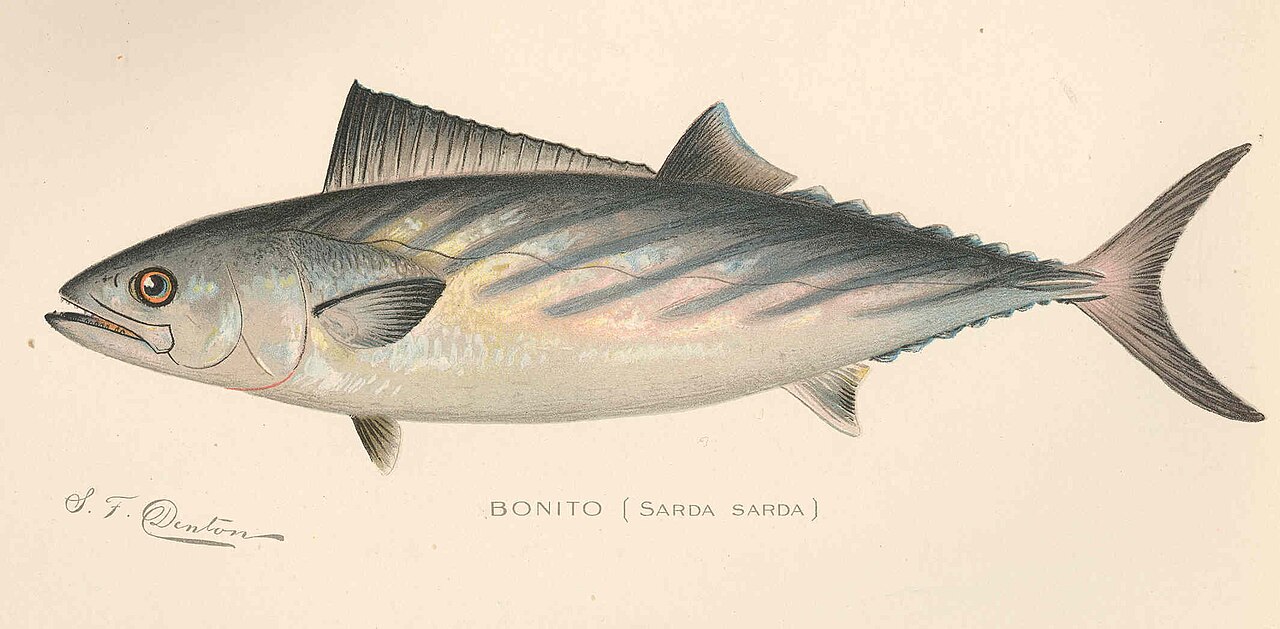
Is bonito kosher? Yes. Bonito is a kosher fish, because it has fins and scales and the Orthodox Union lists the bonito genus (Sarda) among the kosher tuna and mackerel family. The catch is the label. Many cans, flakes, and fish counters use the word “bonito” for more than one fish, so check the species and the certification on any product. You can look up bonito and 290+ other fish on the full kosher fish list.
The short answer on whether bonito is kosher
The Torah sets one test for sea creatures. Leviticus 11:9-12 and Deuteronomy 14:9-10 say a fish is kosher if it has both fins and scales. Bonito meets that test. The Orthodox Union (OU) kosher fish list, which Chabad.org reprints with permission, gives the answer in two places. It lists “Bonitos (Sarda species)” in the same entry as tunas and mackerels. It also has a cross-reference line that sends readers who look up “Bonito” to the entries for cobia and mackerels.
The Kashrut Authority in Australia agrees. Its “Common Kosher Fish” page lists bonito with no note or qualifier. So you have two separate kosher bodies on two continents that treat bonito as a kosher fish. If you want the single-fish page, we give the same verdict on our bonito entry.
Why bonito passes the fins and scales test
Bonito belongs to the family Scombridae, the same family as tuna and mackerel. Wikipedia places the genus Sarda in the tribe Sardini, the bonito tribe, and counts four species in it. Two you’ll see by name are Atlantic bonito (Sarda sarda) and Pacific bonito (Sarda chiliensis).
The OU doesn’t list the fish by its anatomy. It lists the genus, so the verdict covers the whole group. An editor’s note on the Chabad.org reprint says the list only shows which species are “generally considered kosher” and that its use in practice is “very limited.” Market names explain why, and we cover them below.
We explain the scale rule in plain words in our guide on what makes a fish kosher. Kosher scales are the kind that lift off without tearing the skin. That is why sturgeon and shark fail even though they technically have scales in the biology sense.
Bonito vs tuna, mackerel, and cobia
People ask because bonito looks like a small tuna. The OU list treats bonito, tuna, and mackerel together under one entry. Cobia is a separate fish (Rachycentron canadum), but some sellers call it “black bonito,” and the OU list includes it under that name too. This table shows how the neighbors compare.
| Fish | Kosher? | Source and condition |
|---|---|---|
| Bonito (Sarda species) | Yes | OU list, Kashrut Authority of Australia. Check the species name on the package |
| Tuna | Yes | OU list. Canned or processed tuna needs a reliable hechsher |
| Mackerel | Yes | OU list. Do not confuse with snake mackerels, which the OU excludes |
| Cobia | Yes | OU list, as “Cobia, cabio, or black bonito.” A different family from true bonito |
| Dried bonito flakes (katsuobushi) | Needs a hechsher | Processed fish product. Look for a hechsher on the package |
The OU entry carries one exclusion worth knowing. It lists the mackerel and tuna group “but not including snake mackerels.” So the mackerel family is not a blanket yes. We cover those two in full in our posts on whether tuna is kosher and whether mackerel is kosher.
Market names: what “bonito” can mean on a label
The word bonito is slippery. Wikipedia notes that people sometimes call skipjack tuna (Katsuwonus pelamis) bonito. The Kashrut Authority lists skipjack among its kosher tunas, so that mix-up still lands on a kosher fish. Sellers stretch the name even further with cobia. The editor’s note on the Chabad.org reprint of the OU list warns that “the common, unscientific, names of fish are very inaccurate.” The note points out that sellers put names like tilapia, tuna, and snapper on several species, and not all of them are kosher. The editor also quotes the FDA, which calls species substitution “a very serious problem.”
Chabad.org makes the same point in its article on tuna. The article states that many varieties of fish can go by the same name even though one may be kosher and another is not, and that swapping one fish’s meat for another is apparently common in the industry. So for bonito, the safe habit is to find the Latin name (Sarda) or a hechsher. A bare “bonito” on a menu or a bag proves less than you would like.
Fresh bonito, fillets, and the skin rule
Fresh whole bonito with its skin and scales on is easy. You can see the signs of a kosher fish yourself. A fillet is harder. Star-K updated its fresh fish policy on July 16, 2025. It says rabbis prohibit eating a fish whose scales someone removed, such as a skinless fillet, unless a Jewish person confirmed it was a kosher fish. A Star-K supervised counter can sell you skinless fillets, since a mashgiach stands there during the filleting. A store with no kosher supervision cannot.
Star-K also says that it does not recommend buying a whole fish at a non-kosher store and having the staff fillet it while you watch, unless you have no other choice. If you buy fish with the skin on and cut it at home, those concerns go away. We walk through the counter questions step by step in our guide to buying kosher fish.
Bonito flakes, dashi, and canned bonito
Most readers who search “is bonito kosher” are not standing at a fish counter. They are looking at a bag of dried bonito flakes or a bowl of ramen. Producers make katsuobushi, the dried flakes in dashi, by simmering, smoking, and drying fish fillets. Wikipedia says the fish is skipjack tuna, and that shaved katsuobushi and dried kelp (kombu) make up dashi.
That makes katsuobushi a processed fish product. Chabad.org tells readers that a reliable kosher agency must certify all canned, smoked, pickled, or otherwise processed tuna. Bonito flakes are processed fish too, so the same rule fits them. Once the skin and scales are gone, nobody can confirm the species by sight. So a kosher fish does not make the flakes kosher by itself. The flakes need a hechsher on the package.
We did not find a certifier listing for katsuobushi that we could cite, so we will not name a brand. If you cook Japanese food, read the label on the flakes, the instant dashi powder, and any bottled noodle broth. Many of those use bonito extract. We list the other places cooks tuck fish into Japanese food in our kosher sushi guide.
- Whole bonito, skin and scales on: the species is kosher, and you can check it yourself.
- Skinless fillet: buy it from a kosher-supervised counter.
- Canned, smoked, or pickled bonito: look for a reliable hechsher.
- Dried bonito flakes, dashi powder, and broths: look for a hechsher and read the ingredient list.
Bonito on Shabbat and the holidays
You can serve bonito on Shabbat once you have a whole fish or a supervised fillet. None of the OU, Chabad.org, or Star-K material we read treats bonito differently from other kosher fish at a holiday meal. We cover what to plan around the day itself in our kosher for Shabbat guide.
Fish is pareve, so you can serve it at a dairy meal. Meat is a different story. The Shulchan Aruch (Yoreh Deah 116:2) keeps fish and meat apart as a health matter, so families serve bonito as its own course with a clean break before the meat. We explain how kosher kitchens handle it in our post on eating fish and meat together.
Check Any Fish with KosherFish
When a fish name on a menu or label is unclear, a quick lookup beats guessing. You can look up bonito and 290+ other species on the KosherFish list, or use the lookup tool to search by name. At the store, you can check a fish in seconds with the iOS app or the Android app. KosherFish is an information tool and not a posek, so for anything in doubt, ask your own rabbi or look for a reliable certification.
Bonito kosher FAQ
Is bonito fish kosher?
Yes. The Orthodox Union lists “Bonitos (Sarda species)” in its kosher entry for tunas and mackerels, and the Kashrut Authority of Australia lists bonito among its common kosher fish. Both rest on the Torah test in Leviticus 11:9, fins and scales. Confirm the species on the package, because sellers use the name bonito loosely.
Why is bonito kosher?
Bonito is kosher because it meets the Torah rule that a fish needs both fins and scales (Leviticus 11:9-12 and Deuteronomy 14:9-10). It belongs to the same family as tuna and mackerel. The OU kosher fish list names the bonito genus in the same entry as those fish.
Are bonito flakes kosher?
Not automatically. Bonito flakes, or katsuobushi, are a processed fish product. Chabad.org says a reliable kosher agency must certify processed tuna, and the same reasoning applies to processed bonito. Buy flakes, dashi powder, and broths only with a reliable hechsher on the package.
Is bonito the same as tuna?
No, but they are close relatives. Both belong to the family Scombridae, and the OU lists bonitos, tunas, and mackerels in one entry. The names also overlap in the market. Wikipedia notes that people sometimes call skipjack tuna bonito, so a label that says bonito can mean skipjack.
Is canned bonito kosher?
Only with certification. Once fish goes into a can, you can’t see the skin and scales, so nobody can confirm the species by eye. Chabad.org says all canned, smoked, pickled, or otherwise processed tuna must carry a reliable kosher certification. Look for the symbol of a recognized agency such as the OU, cRc, Star-K, or OK before you buy.
Is bonito kosher for Shabbat and the holidays?
Yes, the fish itself is. Whole bonito with skin and scales on is the simplest choice. For a fillet, Star-K says a skinless fillet needs a kosher-supervised counter. Fish is pareve, but Jewish law keeps fish and meat apart, so serve it as a separate course before any meat.
Is dashi kosher if it has bonito?
Only if the dashi product carries a reliable kosher certification. Traditional dashi uses shaved katsuobushi and kombu. Katsuobushi is processed fish, so the finished broth needs a hechsher. With a kombu-only dashi, you skip the fish question altogether, though you should still check the package.
The Bottom Line
Bonito is kosher. The OU lists the bonito genus with the kosher tunas and mackerels, and the Kashrut Authority of Australia lists bonito too. The risks sit in the name and the processing, so check the species and look for a hechsher on flakes, cans, and broths. See the bonito page, browse the full kosher fish list, or start from the lookup tool. The apps are one tap away on iOS and Android. For more, read about tuna and when fish needs a hechsher.