
Is gar fish kosher? No. Gar is covered in hard, interlocking ganoid scales that can’t be removed without tearing the skin underneath, so it fails the Torah’s fins-and-scales test. You can confirm the status of gar and 290+ other species with the KosherFish lookup tool, but the short version is this: if a fish shows up on the gar family tree, it’s off the list.
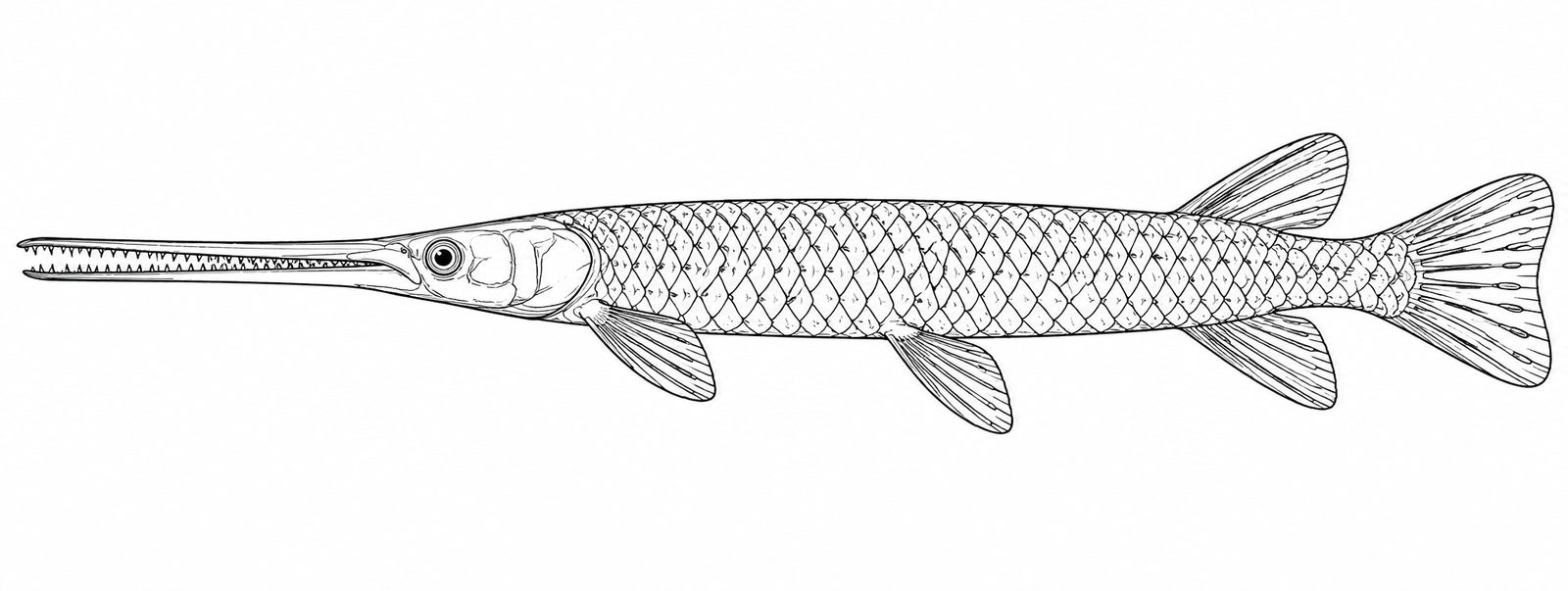
Is Gar Fish Kosher? The Scales Say No
Leviticus 11:9-12 and Deuteronomy 14:9-10 set the rule: a kosher fish needs fins and scales. But “scales” means something specific in Jewish law. The scales have to be the kind you can peel off by hand or with a knife without tearing the skin underneath, what poskim call ctenoid or cycloid scales. Gar fails that test. Its body is armored in thick, diamond-shaped ganoid scales coated in an enamel-like substance called ganoin. They interlock like plate armor, and early naturalists actually used them as arrowheads and scraping tools because they don’t come off without tearing skin loose with them. Pull one away from a gar and you tear the skin with it.
That’s the same failure that makes sturgeon and paddlefish non-kosher. All three belong to older lineages of ray-finned fish that kept their ancestral ganoid armor instead of evolving the thinner, overlapping scales most modern fish have. Gar, sturgeon, and paddlefish technically have “scales” in the biology-textbook sense, but not the halachically valid kind, so the fins-and-scales rule rules them out.
It’s worth being clear that gar isn’t disqualified on the fins half of the rule. Like most fish, gar has normal fins, dorsal, pectoral, pelvic, anal, and a tail fin, so a reader skimming the Torah’s “fins and scales” phrase might wonder why gar fails at all. The fins are fine. The scales are the entire problem, and it only takes one half of the two-part test failing for a fish to be ruled out. That’s also why “it has scales, so it must be kosher” is a common but wrong shortcut. The rule isn’t just fins and scales in the loosest biological sense, it’s fins and scales of the specific removable kind.
The same Torah chapter extends a version of this test to land animals (split hooves, chewing the cud) and birds, and it’s blunt about what fails: those creatures are called detestable, an abomination to eat. For fish, true scales and fins are the whole test, no species-by-species list required. Common kosher fish like salmon, tuna, herring, cod, trout, sardines, and anchovies all carry true scales that lift off cleanly, which is why they’re accepted as kosher without controversy. Shellfish like shrimp, lobster, and oysters fail the same chapter for a different reason, they have no fins or scales at all. Gar sits in between: it has real fins, just not the accepted kind of scales.
What the Kosher Authorities Say
Both the Orthodox Union (OU) and the Chicago Rabbinical Council (cRc) classify gar as not kosher, grouping it with sturgeon and paddlefish as ganoid-scaled species that don’t meet the fins-and-scales standard. The KosherFish entry for gar puts it directly: gar “are armored with hard, interlocking ganoid scales that can’t be removed without tearing the skin, so they don’t meet the kosher standard and are not kosher.”
There’s one nuance worth knowing here, because it shows the ruling comes from actually checking the scales, not just guessing from the family tree. Bowfin, a fish that swims in some of the same waters as gar and was historically lumped in with the “ganoid” group, turned out on closer rabbinic inspection to have cycloid scales without the ganoin coating, the kosher kind. OU Kosher’s own writeup on the case describes a rabbi physically testing a bowfin specimen and finding the scales came off cleanly enough to meet the standard. Gar scales don’t behave that way. Nobody who has tried to clean a gar describes it as easy, which is exactly why the ruling holds.
Unlike swordfish, which carries a documented historical machloket among poskim, gar isn’t a contested case. The OU and the cRc, the two agencies whose published fish lists and rulings address ganoid-scaled species directly, both rule the whole group out on the same scale-removal standard. If you ever see a kosher certification claim on a product made from gar, that would be the one thing worth checking directly with the certifying agency rather than assuming, since no hechsher can override a species that fails the base fins-and-scales test. Sturgeon and paddlefish caviar follow the same logic. Since neither parent fish is kosher, neither is its roe, the same reason canned or processed products from a non-kosher species can’t be fixed by certification after the fact.
Gar vs. Its Non-Kosher Relatives
Gar isn’t an isolated case. It belongs to a small club of fish whose scales look armored rather than flaky, and every one of them fails the same test for the same reason. Here’s how gar stacks up against the fish it’s most often mentioned alongside:
| Fish | Kosher? | Why |
|---|---|---|
| Gar | ❌ No | Hard ganoid scales can’t be removed without tearing the skin (OU and cRc) |
| Sturgeon | ❌ No | Same ganoid-scale problem, the best-known example of this rule |
| Paddlefish | ❌ No | Also ganoid-scaled, often sold as a cheaper caviar substitute |
| Bowfin | ⚠️ Check | Cycloid, not ganoid, scales on close inspection. OU has examined it case by case |
| Catfish | ❌ No | No scales at all, an even clearer case than gar |
| Salmon | ✅ Yes | Fins and easily removable cycloid scales (OU and cRc list it kosher) |
Why People Even Ask About Gar
Gar doesn’t show up at the fish counter the way salmon or tilapia do, so the question usually comes from somewhere specific: a Gulf Coast angler who just landed one, a Cajun court-bouillon recipe calling for gar, or someone who ran across “garfish” on a menu or a hunting-and-fishing forum and wondered whether it’s worth asking a rabbi about. It’s a legitimate question. Gar flesh is edible and does get eaten, mostly in Louisiana and Texas, the two states where river and coastal communities most often land alligator gar and longnose gar. The kosher answer just doesn’t depend on whether a fish is edible or popular somewhere, it depends on the scales.
Gar is also an old lineage, which is part of why it kept the armored scales most modern fish lost. There are seven living gar species in the family Lepisosteidae, and per NOAA and standard ichthyology references they’re among the last survivors of a group that first appeared more than 240 million years ago, in the Triassic period, long before most fish families existed. Alligator gar is the biggest of the seven, regularly reaching 6 to 7 feet. They live in fresh and brackish water across eastern North America, Central America, and Cuba, and occasionally range into coastal seas too. None of that history changes the kosher status, but it explains why the scale type is so different from a typical dinner-table fish.
Gar vs. Pike: A Name-Based Mix-Up
Gar’s other common name is “garpike,” and that’s where a mix-up can happen. Despite the name, gar isn’t closely related to pike at all. True pike belongs to the family Esocidae, a completely different lineage with ordinary cycloid scales, and pike is generally treated as kosher by the standard authorities. Gar belongs to Lepisosteidae, the ganoid-scaled holostean group, and is not kosher. If you’re buying fish by name rather than by species, “garpike” and “pike” are close enough on paper to cause a mistake, so it’s worth confirming which fish you actually have before assuming either way. When in doubt, check the species against the kosher fish list rather than going by a common name alone.
A Buying and Safety Note
This one isn’t a kashrut issue, but it’s worth knowing if gar ever crosses your path: gar roe is toxic to humans and most mammals, even after cooking. Anyone cleaning a gar needs to discard the eggs rather than treat them like another fish’s roe. Since gar isn’t kosher to begin with, this mostly matters for home cooks and anglers rather than kosher kitchens, but it’s the kind of detail worth knowing if you’re ever handed a whole gar and asked what to do with it.
For a kosher kitchen, the practical takeaway is simpler than the biology. You don’t need to identify a scale type under a microscope at the grocery store. If a fish is labeled gar, garpike, alligator gar, or longnose gar, treat it as not kosher and move on, the same way you’d treat sturgeon or shark. The only reason to dig into the ganoid-versus-cycloid distinction at all is curiosity about why the rule lands where it does, not because the buying decision is ever in doubt. For context, a fish that does pass the test is pareve, not meat or dairy, which is a separate question from the one gar never gets to.
Check Any Fish with KosherFish
If you’re staring at a fish you don’t recognize, whether it’s a strange catch, an unfamiliar name on a menu, or a fillet with no obvious scales left, you don’t have to work out the ganoid-versus-cycloid question yourself. You can look up gar and 290+ other species on the full kosher fish list, or check any fish in seconds with the iOS app or on Android, right from the dock, the store, or the dinner table.
Frequently Asked Questions
Is gar fish kosher?
No. Gar fish is not kosher because its hard, interlocking ganoid scales can’t be removed without tearing the underlying skin, which fails the Torah’s fins-and-scales test in Leviticus 11:9-12. The Orthodox Union and the cRc both classify gar as non-kosher, grouping it with sturgeon and paddlefish for the same reason.
Why isn’t gar fish kosher?
Gar is armored in thick, diamond-shaped ganoid scales coated in an enamel-like substance. Kosher law requires scales that lift off cleanly without tearing the skin, the ctenoid or cycloid kind. Ganoid scales interlock like armor plating and don’t meet that standard, the same reason sturgeon and paddlefish are also not kosher.
Is alligator gar kosher?
No. Alligator gar, the largest of the seven living gar species, has the same hard ganoid scales as every other gar species. Size and species within the gar family don’t change the answer. The scale type is what fails the kosher test, and all gar share it.
What other fish have the same scale problem as gar?
Sturgeon and paddlefish are the classic examples, both ganoid-scaled and both not kosher for the same reason as gar. Bowfin looks similar and swims in some of the same waters, but the OU has found bowfin actually has cycloid scales on close inspection, the kosher kind, so it’s judged case by case rather than ruled out automatically.
Does gar need a kosher certification?
No. Certification only matters for fish that are kosher to begin with, to confirm species and prevent cross-contamination once skin and scales are removed. Since gar fails the fins-and-scales test outright, no hechsher can make it kosher. The certification question only applies to fish like salmon or tuna once they’re filleted or processed.
Can you eat gar fish at all?
People do eat gar, mostly anglers and home cooks in Gulf Coast states where alligator gar and longnose gar are a known catch, often in a Cajun court-bouillon. It’s edible by general food-safety standards, aside from the roe, which is toxic and must be discarded. None of that changes the kosher answer, which comes down to the scales, not whether the fish is eaten elsewhere.
Is gar roe safe to eat?
No. Gar eggs contain a toxin that’s poisonous to humans and most mammals, even after cooking. Anyone cleaning a gar should discard the roe entirely rather than treat it like another fish’s eggs. This is a food-safety fact, not a kashrut rule, but it matters if you’re ever handed a whole gar.
The Bottom Line
Is gar fish kosher? No, on all seven living gar species. Its hard, interlocking ganoid scales can’t be removed without tearing the skin, the same reason sturgeon and paddlefish don’t make the list either. If you want the full picture on how the fins-and-scales rule works, read what makes a fish kosher, see how gar compares to the rest of the non-kosher lineup in the non-kosher fish guide, or check gar’s closest kosher-law cousin in is sturgeon kosher. For anything you catch or spot on a menu, the kosher fish list and the KosherFish lookup tool cover all 291 species, and the iOS and Android apps keep the answer in your pocket. If a specific case still feels unclear, a reliable kosher certification agency or your own rabbi is the right place to confirm it.